
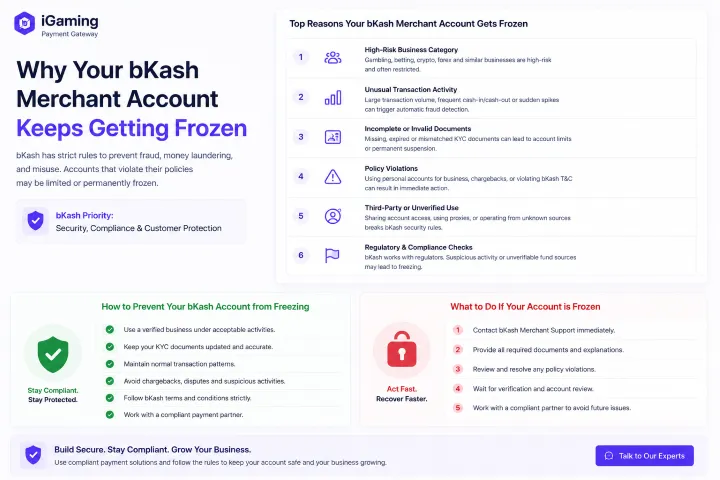
Why Your bKash Merchant Account Keeps Getting Frozen: The Pattern Behind the Pattern, and Why Appeals Won't End the Cycle
A bKash merchant account that keeps getting frozen is not running into bad luck — it is running into a recurring set of signals that any mobile-financial-services merchant-risk system flags by design. Most operators respond by appealing each freeze, waiting out the review, and resuming operations until the next freeze. The cycle continues because each appeal addresses the symptom, not the trigger. This page is about the actual triggers — and the structural fix that stops the cycle.
You've been here before. The deposits suddenly stop landing. Players ping support. You open the merchant dashboard and see the word that's becoming familiar: restricted. You spend a week working through the appeal. The funds eventually release. Operations resume. And then, three or four weeks later, the same email arrives again. Getting unfrozen is not the same as fixing the problem.
The Freeze Cycle, Mapped
The first thing worth doing is drawing the cycle itself. Operators living inside it often don't recognise how routinely they're traversing the same four stages — partly because each individual stage feels like an event, not part of a pattern.
The Trigger Signals That Actually Fire the Freeze
Mobile-financial-services merchant-risk systems don't freeze accounts on hunches; they freeze on signals. Knowing which signals are firing in your direction is the first step in any honest diagnosis. Six are repeatedly relevant for high-volume iGaming-aligned merchant accounts:
Sudden velocity ramps
What gets flagged: A merchant account whose daily transaction count jumps 3–5× over a short window. Looks like fraud or money-laundering on a generic risk model.
Concentrated time-of-day patterns
What gets flagged: Most volume concentrated in late-night or weekend windows rather than business hours.
High repeat-payer density
What gets flagged: The same end-customer numbers depositing repeatedly across days/weeks. Looks like layering on a generic AML lens.
Mismatch between declared business and actual flow
What gets flagged: The merchant onboarded under a generic business description, but the actual transaction pattern doesn't match. Triggers manual review.
Player complaints reaching the wallet operator
What gets flagged: End customers contacting the wallet operator about a transaction with your merchant. Each complaint is a small signal; they accumulate quickly.
Reconciliation gaps between merchant and rail
What gets flagged: Discrepancies between transactions the rail thinks completed and the records the merchant reports. Looks like operational chaos to risk.
The First Five Days of a Freeze, Honestly
An operator who has been through a freeze before recognises the pattern of what the first week actually looks like. Worth naming explicitly so you can plan against it rather than discover each stage in real time:
The Appeals Anti-Pattern
The single most common mistake operators make is conflating "we got reinstated" with "we fixed the problem." The appeals process is a symptom response, not a fix. Each tactical appeal replaces a structural decision that should have been made up the stack. The honest contrast:
The Warning Indicators Operators Miss
Freezes don't arrive without warning — but the warning indicators are easy to miss because they look like ordinary operational variance. Watch for these in the days before the next freeze:
Pre-Freeze Warning Indicators
Tactical Fixes vs the Structural Fix
The cycle ends when the operator stops responding to each freeze tactically and addresses the actual structural problem upstream. The two paths look like this side-by-side:
Appeal each freeze, repeat
- Engage each freeze as a one-off event
- Submit documents proving this specific case
- Get reinstated, hope it doesn't happen again
- Wait 3–6 weeks for the next freeze
- Recurring lost-revenue periods + accumulating player churn
- Operations team's calendar dominated by appeals
Use a stack the rails were built for
- Engage a specialist iGaming gateway whose acquiring is purpose-built for the vertical
- Multi-rail routing — a single rail's restriction shifts traffic, doesn't kill the cashier
- Risk model tuned for iGaming traffic patterns, not generic e-commerce
- Reconciliation built-in, signal-clean by design
- No appeal cycle to live inside
- Operations team's calendar dominated by growth, not survival
The deeper framing of why Bangladesh-specifically requires a dual-wallet stack — not just bKash — and how a managed branded gateway routes between bKash and Nagad so a freeze on one rail isn't a deposit blackout, lives in our bKash and Nagad payment gateway article. The broader Bangladeshi market context — regulatory framing, the dual-wallet imperative, operator-side weekend rhythm — is on the Bangladesh iGaming payment gateway page.
The Operator Reality Most Vendors Won't Discuss
Two pieces of honest context that don't usually make it into vendor conversations:
bKash is not the villain here. It's an excellent mobile financial service that operates by the same merchant-risk rules every regulated MFS in the region uses. The freezes are produced by the intersection of its risk model — designed for the median Bangladeshi commerce merchant — and your traffic shape, which is not the median. Neither is wrong; they're misaligned.
Direct-onboarded merchant accounts on mobile wallets are not the stable structure most operators imagine. They feel like ownership ("we have our own merchant"); operationally they behave like a tenancy that can be revoked. A specialist gateway with appropriate acquiring relationships absorbs this fragility into its own infrastructure, so the operator no longer feels each rail's risk decisions as a binary up-or-down on their business.
Everything Else, Compressed
What causes the cycle: Six recurring trigger signals — velocity ramps, concentrated time-of-day, repeat-payer density, business-description mismatch, player complaints reaching the rail, and reconciliation gaps. Generic risk models flag all of these in iGaming-shaped traffic.
Why appeals don't fix it: Each appeal addresses the specific freeze; the underlying triggers continue to fire. Three to six weeks later, the same pattern produces the same outcome.
What actually fixes it: A specialist iGaming gateway with acquiring built for the vertical, multi-rail routing so a single rail's freeze isn't a blackout, and reconciliation discipline that doesn't generate operational-quality signals.
The cycle isn't a phase to live through — it's a structure to leave.
Stop calendar-blocking appeals. Start operating on a stack the rails were built for.
Break the Cycle →Freeze Cycle FAQ
Is there a way to know which trigger fired my most recent freeze?
Rarely with full precision — risk teams generally don't enumerate the specific triggers in their notifications. The right approach is to assume multiple triggers are accumulating in parallel; addressing one without addressing the others usually just delays the next freeze.
If we slow down our deposit velocity deliberately, will the freezes stop?
Probably not, because velocity is rarely the sole trigger. Slowing down also reduces revenue without addressing the underlying business-shape mismatch. Throttling your way to stability is a worse trade than addressing the structural problem.
What about opening a second bKash merchant account under a separate entity?
Sometimes works briefly; rarely works durably. Wallet risk teams correlate connected entities, and the cycle resumes on the new account. A multi-rail, properly-acquired specialist gateway is the genuine resilience play.
How long does the structural fix actually take to implement?
Weeks, in most cases. The slow part is usually the operator's own internal decision-making — finance, legal, product alignment — rather than the technical migration to a specialist gateway. Operators who decide quickly are operating freeze-free within the same quarter.
Can we keep our direct bKash account alongside a specialist gateway?
Yes, and many operators do — for as long as it remains operational. The point is to stop being structurally dependent on it. When a single rail is one of several, its freezes become operational hiccups rather than business-stopping events.
What happens to the funds currently held in the frozen account?
They typically release with the reinstatement, on the rail's standard timing. The held funds are recoverable; the lost players during the freeze window often aren't, which is the more important number on the spreadsheet.
Is this issue specific to bKash, or do we hit the same pattern with Nagad and others?
The pattern is industry-wide for MFS merchants whose traffic shape doesn't match the median use case. Different wallets express it slightly differently, but the same trigger family applies. A genuinely resilient stack assumes any single rail can freeze and architects accordingly.
The Next Step
A bKash merchant account that keeps getting frozen is not asking for a better appeal letter — it's signalling that the structural arrangement of your payment stack needs to change. The operators who escape this cycle are the ones who stopped treating each freeze as an event and started treating the cycle itself as the problem. The operators who don't escape are the ones still drafting their fifth appeal letter.
Tell us how many freeze cycles you've been through, how recent the last one was, and what your Bangladeshi player base looks like. We will walk through the structural alternative against your specific situation — and you'll see, in a single conversation, whether the cycle is something you have to keep living inside.
You're not unlucky. The structure is wrong.
Move from appeals-as-routine to operations-as-routine.
Talk About a Resilient Stack →