
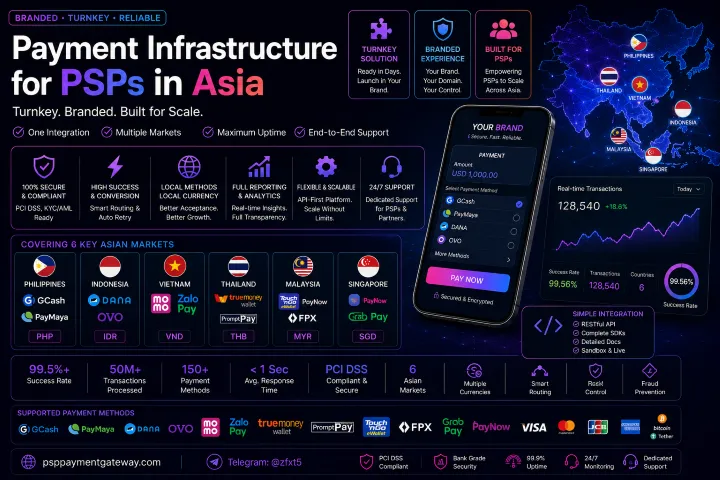
Payment Infrastructure for PSPs in Asia | Turnkey, Branded: Your Downstream Operators Get a Branded Cashier in Days. Your Margins Stay Yours.
Payment infrastructure for PSPs in Asia is a different conversation from a payment gateway for operators. PSPs sell payment service to many downstream operators — and the only metric that genuinely compounds for a PSP business is the speed at which a new downstream tenant can be provisioned, branded, and taken live. A turnkey, multi-tenant infrastructure built specifically for PSPs collapses that timeline from months to days, while keeping the resale margin firmly on the PSP side of the table.
Run a PSP and you know which deals close and which die. The ones that die almost always die in the same place: a downstream operator who liked the pitch, asked when they could go live, heard "six to eight weeks for setup," and quietly went somewhere else. Speed-to-tenant is the only competitive lever PSPs have that compounds. This page is about turning that lever, deliberately built for the PSP side of the desk.
Your PSP Sits in the Middle of a Star, Not a Pipe
The standard "payment gateway" mental model is linear: one cashier, one operator, one set of merchant accounts. The PSP mental model is fundamentally different — your business is a hub that has to spin up many of these per-operator deployments and operate them as a portfolio.
The Multi-Tenant Architecture Underneath
What makes this scale is the architectural separation between the shared infrastructure layer and the per-tenant branded surface. The core runs once; the brands stack on top:
From Signed Contract to Live Cashier — Days, Not Months
The single most powerful sales weapon a PSP has is the answer to "when can we go live?" When the honest answer is "days" instead of "months," conversions on operator pitches change shape. Here's what the turnkey provisioning of a new downstream operator actually looks like end-to-end:
"Days, not months" isn't a marketing slogan in this context — it's the unit you compete on. A PSP that can stand a tenant up in this window wins deals that a PSP quoting "six to eight weeks" doesn't even get to bid on.
The PSP Margin Math, Spelled Out
Turnkey speed is only half the value. The other half is the per-tenant unit economics — what each new operator on your stack actually does to your P&L. The structure that makes PSP-side margin work looks like this:
Per-Tenant Margin Pattern
What "Turnkey" Specifically Includes
"Turnkey" is a word that gets stretched. For a PSP, it has to mean something concrete: can I sell this to my downstream operators without having to do the integration work that an infrastructure shop is supposed to do? Here's what's actually included on the PSP-resellable side:
What You're Actually Reselling Downstream
The honest framing of the PSP value proposition to a prospective downstream operator goes something like this — and "turnkey" is what makes every line of it true:
"Live in days, not months."
The provisioning timeline above is the timeline you can promise — and keep.
"Your brand. Your domain."
Their cashier wears their name. Yours is invisible to their players. They look like the gateway operator.
"Local rails ready-wired."
The Asian wallets and rails are already integrated. The operator gets coverage from day one, not a roadmap.
"24/7 operations included."
The downstream operator doesn't need their own ops team. The pager isn't theirs and it isn't yours either.
"Scale across markets without re-platforming."
The operator can add a country and you can deliver — same stack, new configuration.
"Transparent, scoped pricing."
The downstream operator gets a clean line item. You keep the margin. Nobody plays games with the spread.
Why This Page Skips the Operator Conversation
Operators have their own dedicated page on this site
Most pages on this site address operators and PSPs in the same article. This one doesn't — by design. The turnkey, multi-tenant, margin-aware framing is specifically a PSP conversation. The operator-side framing of the same managed stack — including the latency and hosting dimensions that matter most for player-facing operators — lives on our dedicated payment gateway for iGaming operators in Asia | branded, hosted page.
For the brand-sovereignty foundation underneath every branded tenant your PSP provisions — domain ownership, merchant account control, what "branded" actually means structurally — see our branded payment gateway for gaming operators article. The turnkey resale model only works if the underlying branded foundation is solid; that piece is described there.
Everything Else, Compressed
Scope of this article: The PSP-side framing of a turnkey, multi-tenant, branded payment infrastructure for Asia. Operator-side framing lives elsewhere; this page is specifically the reseller conversation.
Pricing structure: Per-tenant flat monthly hosting fee + 0.1–0.4% transaction volume share. You set the price you charge your downstream operators; the spread is your margin.
What you bring as a PSP: downstream operator relationships, brand decisions per tenant, merchant relationships per tenant (or the willingness to help your downstreams set them up). What we run: the multi-tenant infrastructure, per-tenant provisioning, 24/7 ops, reconciliation roll-ups, and ongoing development across all your tenants.
Provision your next tenant in days. Bill them this month.
Stop quoting "six to eight weeks" while your competitors quote "we go live next week."
Talk About the PSP Stack →PSP-Specific Questions
How many tenants can the multi-tenant stack scale to?
Horizontally — the core scales with usage rather than tenant count. Adding tenants is a configuration cost, not an infrastructure-redeployment cost. There isn't a hard cap that we'd disclose generically; volume-driven scaling is part of the engagement.
Do my downstream operators ever know who's behind the stack?
Not from anything we render. There's no "powered by" footer on tenant cashiers, no vendor reference in their dashboards, no third-party domain in their checkout flow. If you choose to disclose it for transparency, that's your call — never forced from our side.
Can each tenant have different pricing terms with us?
The wholesale terms between us and you are typically uniform across tenants — that's how the math stays clean. What you charge each downstream operator is your decision, and the margin is yours to set per tenant or as a standard rate card.
What if a tenant churns — does that affect my other tenants?
No. The multi-tenant separation means each tenant is operationally independent. Removing or pausing one tenant doesn't touch the others; you don't end up replatforming because one downstream operator left.
Can I have different verticals (casino, sportsbook, fantasy) per tenant?
Yes. Each tenant configures its own vertical mix. The same underlying infrastructure serves a slots-focused tenant and a sportsbook tenant differently, with appropriate tuning per vertical applied automatically.
Do I get a unified reporting view across my tenants?
Yes. Per-tenant detail plus PSP-level roll-up. Your finance team sees the aggregate; your account managers can drill into individual tenant health without losing the top-line view.
What happens to a tenant if I, as the PSP, change strategy or wind down?
The tenant's structurally critical assets — their domain, their merchant accounts, their customer database — are theirs from day one. Continuity planning at the PSP level is something we'd scope explicitly with you, including what graceful exit and tenant hand-over looks like.
The Next Step
A working payment infrastructure for PSPs in Asia isn't a single-tenant gateway with optional multi-account features bolted on. It's a multi-tenant, branded, turnkey stack designed from the ground up around the reality of a PSP's business: many downstream operators, per-tenant brand surfaces, sales conversations that compete on speed, and unit economics that have to work per tenant rather than per pilot. The PSPs winning in Asia are the ones whose stack lets them say "live in days" and mean it.
Tell us how many downstream operators you currently serve, which Asian markets they collectively cover, and where you want to be in twelve months. We will scope a turnkey PSP stack around your specifics and price it so each new tenant compounds — not pinches — your margin.
Multi-tenant. Turnkey. Branded per downstream.
The PSP stack built around the only metric that actually matters: speed-to-tenant.
Scope My PSP Infrastructure →