
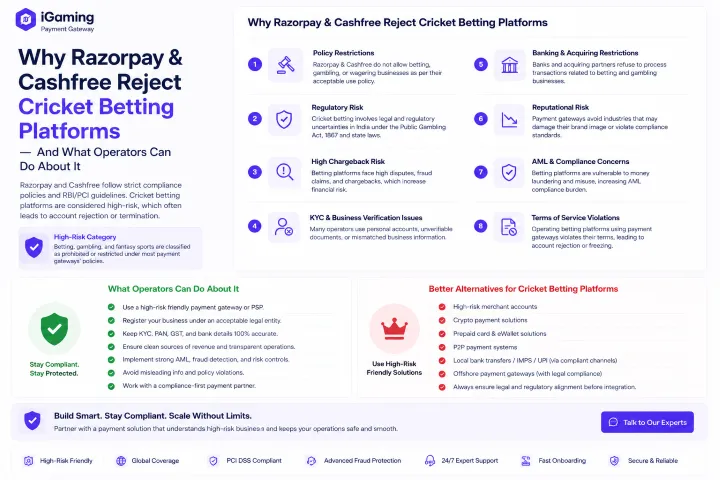
Why Razorpay & Cashfree Reject Cricket Betting Platforms — And What Operators Can Do About It: The Honest Diagnosis Most Vendors Won't Give You
Razorpay and Cashfree rejecting your cricket betting platform is not a personal decision and not a malicious one — it is a predictable structural outcome of how mainstream Indian payment service providers are built. Their business model, their banking partnerships, and their merchant-onboarding policies are designed for legitimate Indian e-commerce, not for gaming/betting verticals. The right response is not to push harder or appeal louder; it's to recognise you need a fundamentally different category of provider.
It's a Tuesday morning. You're a few weeks into trying to onboard cricket-betting deposits through Razorpay, or Cashfree, or any of the mainstream Indian PSPs. The application sailed through identity verification. Then it stalled in business review. Now there's a polite, carefully-worded email that says "we're unable to support your business category at this time." If you've received some version of that email, this page is for you.
The Rejection Email — Decoded
Mainstream Indian PSPs decline gaming/betting applications using a remarkably consistent set of phrases. The wording is deliberately neutral — the language is not designed to be informative; it's designed to be conclusive without being legally awkward. Here is what the standard letter typically says, and what each phrase actually means underneath:
Dear Applicant,
Thank you for your interest in our payment services. We have completed the review of your merchant onboarding application.
After careful evaluation, we regret to inform you that we are unable to support your business category at this time. Our current acquiring partnerships and platform policies do not accommodate the merchant vertical described in your application.
This decision is based on our risk assessment framework and is not a reflection of your business specifically. We encourage you to explore specialised payment providers that focus on your industry.
Regards,
Merchant Risk Team
Why the MCC Code Decides Almost Everything
The single most powerful filter operating against your application is the Merchant Category Code — a four-digit code that every merchant is assigned and that determines which acquirers will or won't process for them. For gaming and betting, the relevant MCC is 7995. Mainstream Indian PSPs do not have acquiring relationships that accommodate this code, full stop. Compare:
The 5 Structural Reasons — Not Excuses
The reasons mainstream Indian PSPs decline cricket-betting platforms are structural, not editorial. Naming them honestly is more useful than guessing at the underlying motive:
Their acquiring banks have categorical policies
Indian PSPs run on top of acquiring relationships with banks. Those banks have portfolio-level policies about which MCCs they accept. A PSP cannot onboard a vertical its banks won't process for — independent of how clean the individual merchant looks.
India's iGaming regulatory landscape is state-level & fluid
Different Indian states treat sportsbook, fantasy, and skill-gaming differently — and the framework evolves. Mainstream PSPs build for predictability, not for jurisdictional complexity that requires per-state legal opinions. The vertical is operationally too costly for them to support.
Chargeback and dispute profiles are different
Gaming traffic has a different chargeback signature from e-commerce. Mainstream PSPs price their acquiring around standard e-commerce assumptions — they're not structured to absorb gaming-specific dispute patterns at their standard rate card.
Volume profile triggers different KYC and AML scrutiny
Cricket-betting traffic includes high-velocity small deposits clustered around events. From an AML monitoring perspective this looks distinct from normal merchant flow and requires specialised tooling that mainstream PSPs haven't built.
Reputational and customer-mix considerations
Mainstream PSPs serve thousands of legitimate e-commerce merchants. Onboarding gaming verticals would change the conversation they have with their other customers and regulators. The decision to stay out of the category is a brand decision as much as a risk decision.
Where Your Application Actually Stalled
A cricket-betting application doesn't get rejected at the start — it gets rejected at a specific stage of the onboarding flow that mainstream PSPs follow. Knowing where the stall happens tells you what is actually being declined:
"Days of silence" between Stage 2 and Stage 4 is the most common operator experience — there is no genuine evaluation happening; the application is queued, awaiting a manual reviewer to confirm what the MCC already implies.
Three Myths That Cost Operators Weeks
Before describing the right path, it's worth dispatching the three biggest myths operators bring into this conversation — each of them costs weeks of wasted time:
Common misconceptions, side by side
Mainstream PSP vs Specialist iGaming PSP — The Honest Comparison
The real conversation isn't "Razorpay or Cashfree?" It's "mainstream Indian PSP or specialist iGaming PSP?" Each is excellent at what they do — for different businesses. The honest comparison:
| Attribute | Mainstream Indian PSP | Specialist iGaming PSP |
|---|---|---|
| Built for | Legitimate Indian e-commerce | High-risk verticals including gaming |
| Acquirer relationships | Banks that decline gaming MCC | Banks & rails that accept gaming MCC |
| Risk model | Standard e-commerce chargeback profile | Tuned for gaming velocity & dispute patterns |
| Cricket peak handling | Generic capacity, not tournament-aware | Capacity sized around the sports calendar |
| UPI integration depth | Generic UPI cashier (e-commerce defaults) | UPI tuned for iGaming traffic patterns |
| Onboarding posture | Rejects gaming applications | Onboards them as the core business |
| Pricing structure | Per-transaction, optimised for low-risk volume | Built for the actual gaming traffic profile |
Both columns describe legitimate businesses; the difference is what each one is structured to serve. Forcing a cricket-betting platform through a mainstream Indian PSP is asking the wrong category of vendor to solve a problem they aren't built to solve.
What Operators Should Actually Look For
The right move after a mainstream PSP rejection is a targeted search for the specialist category — not a louder pitch to the same vendors. Here is the working checklist for evaluating a specialist iGaming provider in India:
What to ask for explicitly
The deeper India-specific framing — local payment-rail mechanics, market-entry considerations, regulatory landscape — lives on our India iGaming payment gateway page. The technical depth on how UPI specifically needs to be integrated for cricket and other iGaming traffic is in our dedicated UPI payment gateway for casino & iGaming article. Both are companions to this rejection-recovery conversation.
The Path Forward — Concretely
For an operator who has just received a polite rejection from a mainstream Indian PSP, the next 30 days look like this:
- Stop appealing the rejection. The rejection wasn't about your business merits; appealing is asking a vendor to do work outside their scope.
- Stop relabelling your product. Cosmetic changes to make your site "look less like betting" generate worse outcomes, not better ones.
- Map your real requirements. Markets, expected volume, UPI integration depth, KYC tier model, settlement preferences, brand control.
- Scope a specialist iGaming PSP. The category of provider whose business is exactly the one you're operating. The conversation is shorter, the path to live is faster, and the structure makes sense.
- Plan the brand-and-domain side now. A specialist gateway typically delivers a branded cashier; deciding on the domain and brand surface in parallel with technical scoping shortens the timeline.
Everything Else, Compressed
Why mainstream Indian PSPs decline: Acquirer-level policies on MCC 7995, state-level regulatory complexity, different chargeback profiles, AML pattern differences, and reputational positioning. None of it is about you specifically.
What to do instead: Engage a specialist iGaming PSP whose business is the vertical you operate in. Same regulatory framework; different acquiring posture; built-for-purpose technology.
What not to do: Don't relabel your business, don't appeal, don't shop the next mainstream PSP. Each of those costs weeks of wasted time and produces the same outcome.
The rejection isn't a verdict — it's a wrong-door problem.
Talk to the category of provider whose business is yours: a specialist iGaming gateway built for cricket-shaped traffic.
Talk to a Specialist →Rejection & Recovery FAQ
Are Razorpay and Cashfree bad payment providers?
No — they're excellent at what they do, which is serving legitimate Indian e-commerce at scale. The point of this article is not to criticise them; it's to explain that they are the wrong category of provider for cricket betting, and to direct operators to the right category. They make the right business decision for their portfolio; you need to make the right business decision for yours.
Will any mainstream Indian PSP onboard us if we get a gambling licence?
Generally no, for the structural reasons described above. Licensing affects your operating posture and your relationship with regulators; it doesn't change the acquiring relationships behind mainstream Indian PSPs, which is the actual filter declining your application.
What's the realistic timeline from "rejected by mainstream PSP" to "live with a specialist"?
Weeks rather than months when you engage the right category of provider. The wasted time is usually spent in the loop of applying to one mainstream PSP after another. Specialist iGaming providers can scope and onboard within a single engagement window because the vertical is what they do.
Should we keep trying mainstream PSPs in parallel?
Not productively. The same MCC and structural filters are applied across mainstream Indian PSPs. Spending energy on appeals or alternative mainstream applications is energy that doesn't compound. Direct that energy at specialist providers and at building your platform.
What if we want to keep using a mainstream PSP for our non-betting revenue (subscriptions, merchandise)?
Reasonable, and common. Mainstream PSPs work well for non-gaming revenue streams alongside a specialist gateway for the gaming flows. The two cohabit cleanly — different revenue lines, different providers, neither one fighting the other's policy.
What's the cost difference?
Mainstream PSPs price for low-risk e-commerce; specialist iGaming PSPs price for the vertical's actual risk and traffic profile. Direct rate comparison is misleading because mainstream PSPs wouldn't onboard your business at any rate. The honest comparison is "specialist's all-in cost" versus "the cost of not having a working cashier" — and the latter is much higher.
What about international PSPs operating in India?
Some international gaming-focused PSPs operate in India, and some are genuine specialists. Evaluate them against the same checklist above — acquirer disclosure, UPI depth, cricket capacity story, KYC tier model, branded vs sub-merchant, written compliance posture, transparent pricing.
The Next Step
A working cricket-betting payment stack in India starts by accepting that Razorpay and Cashfree's rejection is a category signal, not a verdict on your business. The path forward is to engage the category of provider whose work is the work you do. Operators who internalise this within their first rejection cycle are operating their cashier in weeks; operators who keep trying to talk mainstream PSPs into making an exception are usually still trying months later.
Tell us what your platform looks like today, which Indian states you're targeting first, and how recently your last mainstream PSP rejection arrived. We will walk you through the realistic 30-day path to a working cashier — including the questions mainstream PSPs never gave you a chance to ask.
The wrong vendor said no. The right category exists.
Stop appealing rejections from PSPs whose business isn't yours. Start a conversation with one whose business is.
Open the Right Conversation →