
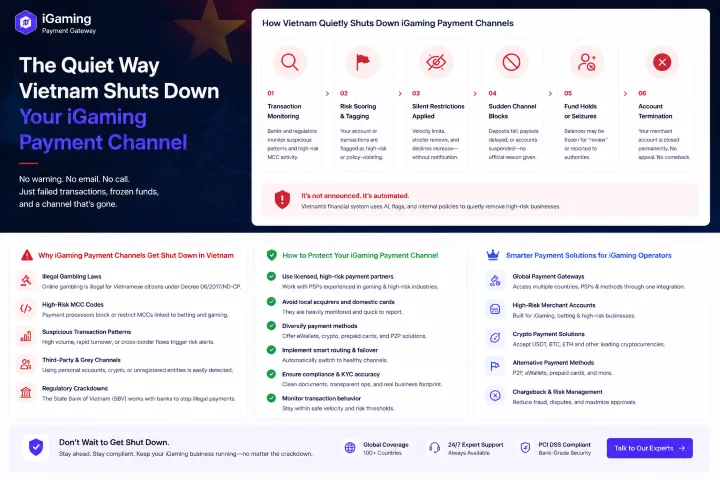
The Quiet Way Vietnam Shuts Down Your iGaming Payment Channel: The Pattern You'll Find in the Approval-Rate Logs, Not the Email Inbox
Vietnam doesn't shut down your iGaming payment channel with an email. It shuts it down with a graph. Your approval rate on the Vietnamese cashier slips from 94% to 88% over three weeks, then to 76%, and you'll think it's a rough month — until you compare the slope to last year's same season. The Vietnamese way of disengaging from a payment merchant is structurally different from the Indian "rejection email" pattern or the Bangladeshi "merchant freeze" pattern. It is, deliberately, quiet. This page is about how to recognise it before you've lost two months of conversion.
You won't get a notification. There won't be a "restricted" status on the merchant dashboard. There will be a trend line, and you have to be looking at it. Operators who learn to read the trend before the trend becomes terminal are the operators whose Vietnamese cashier stays alive. Operators who only react to explicit notifications are the operators who quietly lose the country.
The Graph That Tells the Real Story
The defining visual of a quiet Vietnamese shutdown is a slow downward slope in the approval rate on your MoMo or ZaloPay route. Not a cliff. Not a sudden drop. A smooth drift — week over week, single-digit percentage point at a time — that adds up to a fundamentally different cashier within a single quarter:
The Symptoms You'll Notice First (and Probably Misread)
Before the trend is obvious on a chart, the symptoms show up as everyday operational annoyances — the kind that get logged in Slack as "weird thing today" without escalation. Each of these has a benign explanation; each is also a plausible early signal of a quiet shutdown:
"The Vietnamese route is being a bit slow today"
Latency on your MoMo or ZaloPay route creeps up by a few hundred milliseconds. Other routes feel fine.
"More declines on legitimate-looking players"
Players whose patterns are clearly genuine are getting declined more often. Support tickets reference "I've used this account for months."
"Withdrawals taking longer than they used to"
Settlement times stretching from minutes to hours; occasional ones overnight. The wallet's UI says "processing" longer than it used to.
"Daily caps feel lower than before"
Players hitting transaction-amount or daily-volume limits that they didn't hit a month ago. Your support is unsure if the limits actually changed.
"Reconciliation has small unexplained gaps"
Daily three-way match between gateway, rail, and bank starts showing minor discrepancies. Always within reasonable variance, but recurring.
"In-app messaging feels different to players"
Players report subtle wording changes in the wallet's confirmation screens, or extra verification steps that didn't used to appear.
"Loud" Shutdown vs "Quiet" Shutdown — Why Vietnam Is Different
Compare what an operator experiences in different Asian markets when a payment relationship deteriorates. The contrast matters because the playbook to detect each pattern is fundamentally different. The bKash-style loud freeze is in plain sight; the Vietnamese-style quiet drift hides inside ordinary operations data.
bKash-style freeze
- Email arrives: "restricted"
- Deposits stop instantly
- Funds visibly held
- Appeal process documented
- Player support floods immediately
- You know it's happening the day it starts
Vietnam-style drift
- No notification arrives
- Deposits keep flowing — just less of them, less reliably
- Withdrawals slow, not stop
- No formal appeal to make
- Players churn quietly rather than escalate
- You won't know it's happening unless you're watching the trend
12 Weeks of Quiet Drift, Mapped
Operators who have lived through a Vietnamese drift can usually map the weeks against each other in retrospect. Each individual week was a small datapoint; the line through them was the actual story. The pattern usually plays out something like this:
How to Detect the Drift Early — A Diagnostic Toolkit
Detection isn't magical — it's a set of specific questions you ask of your own data on a recurring cadence. Operators who run this checklist weekly catch drifts at week 4–5 rather than week 9–10. The difference is two months of recoverable revenue.
Three Misreadings That Cost Operators a Quarter
Before describing what actually helps, three diagnostic misreads are worth naming directly — each is a predictable wrong turn that postpones the real fix:
Common misreads of the quiet drift
The Actual Fix — Routing, Not Repair
The quiet drift cannot be reversed through better marketing, prettier UI, or louder customer support. It can be addressed by changing the underlying routing posture so your Vietnamese cashier doesn't depend on a single deteriorating relationship:
What actually breaks the quiet shutdown
The broader Vietnamese-market context — local player behaviour, super-app embedding, language and weekend rhythms — sits on the dedicated Vietnam gaming payment gateway page. This article is the diagnosis-and-detection companion to that broader market view.
The Honest Context — Why Vietnam Tends to Be Quiet
Two pieces of context worth being plain about:
The Vietnamese fintech ecosystem isn't doing anything wrong. Mobile-financial-services providers there operate by perfectly reasonable risk frameworks — frameworks built for the median merchant in the local commerce economy. When a particular merchant's traffic doesn't match the median, the rail adjusts its handling. That adjustment manifests as quiet routing changes rather than loud notifications, partly because Vietnamese fintech norms favour graduated responses over binary cut-offs. It's structurally different from the Bangladeshi "freeze and notify" pattern, and it requires a different operator response.
The fix isn't to push harder. Vietnamese rails don't reverse a quiet drift in response to operator complaints; there usually isn't a clearly-identified decision-maker on the rail side to complain to. The right response is upstream: change the structural arrangement of your Vietnamese payment stack so a single rail's drift is no longer a business-defining event.
Everything Else, Compressed
What "quiet shutdown" actually looks like: a monotonic downward slope in approval rate over 8–12 weeks, accompanied by latency drift, recurring reconciliation gaps, and players churning quietly. No email, no formal notification, no appealable decision.
How to detect early: a weekly diagnostic checklist that asks the right questions of your own data. Caught at week 4, recoverable. Caught at week 10, structurally costly.
The fix: dual-rail routing across MoMo and ZaloPay with VietQR as fallback, on a specialist iGaming gateway whose acquiring relationships are purpose-built for your vertical's traffic shape.
The drift is invisible until you look. So look — weekly.
And when the slope appears, change the stack rather than the symptom.
Audit My Vietnamese Channel →Vietnamese Drift & Detection FAQ
How do we tell normal weekly variance from a genuine drift?
By the slope of the rolling 4-week average against the prior quarter's baseline. A two-point dip in a single week is variance. A four-point drop in the rolling 4-week average that hasn't recovered after another two weeks is a drift, not variance.
If we ask MoMo or ZaloPay directly about the change, will they tell us?
Probably not at the level of detail you'd want. The risk-handling adjustments are operational decisions inside the rail and rarely surface as explicit communications. Asking is useful for relationship maintenance; expecting a clear "we did X because Y" answer usually disappoints.
Can we recover a Vietnamese channel that's already 12 weeks into drift?
Sometimes, but the recovery path is usually structural rather than relational. Moving to a properly dual-railed stack with appropriate acquiring relationships restores the channel to operating health on different infrastructure. Trying to recover the original channel on the original posture rarely works.
Does this happen across other Asian markets too, or only Vietnam?
Quiet drift patterns exist elsewhere but Vietnam tends to express the pattern most clearly because of how its mobile-financial-services norms are structured. Bangladesh tends to be louder (visible freezes), India varies by PSP, and the Philippines sits somewhere in between. Vietnam is the cleanest example of the quiet pattern.
Why doesn't the wallet just tell us what we did wrong?
Because in most cases, you didn't do anything wrong in the sense the question implies. The drift is the rail adjusting its handling of merchants whose traffic shape doesn't match the median. There's no transgression to communicate — there's an operational posture change that doesn't have a natural notification channel.
What's a reasonable alerting threshold for the early-warning indicators?
For approval rate: alert on rolling 4-week average dropping more than 3 points vs the prior quarter. For latency: alert on median round-trip on the Vietnamese route increasing more than 200ms vs the prior month. For reconciliation: alert on the same small discrepancy recurring more than twice in a month. None of these are exotic; they're standard payment-ops thresholds.
Is there any way to make the rail "louder" — i.e., have it notify us when handling changes?
Not directly. The rail is structurally not built for that kind of merchant transparency. What you can do is build your own monitoring such that the rail's quiet changes become loud on your side. That's what the diagnostic checklist above is for.
The Next Step
A quietly-shut-down Vietnamese payment channel is not unrecoverable, but it is unsurvivable on its existing structure. The operators who keep their Vietnamese cashier alive long-term are the ones who built dual-rail routing from day one, who run weekly drift diagnostics, and who treat approval-rate trends with the seriousness they treat customer-acquisition metrics. The operators who don't are the ones who eventually decide "Vietnam isn't a market for us" — when in reality, Vietnam was a market for them on a different stack.
Tell us how long you've operated in Vietnam, what your approval rate has looked like quarter over quarter, and which rails you currently route on. We will run the drift diagnostic against your specific data — and you'll know in a single conversation whether the slope you're seeing is variance or a verdict.
The quiet shutdown ends when you stop being silent about it.
Audit, route, restructure. In that order.
Run the Drift Diagnostic →