
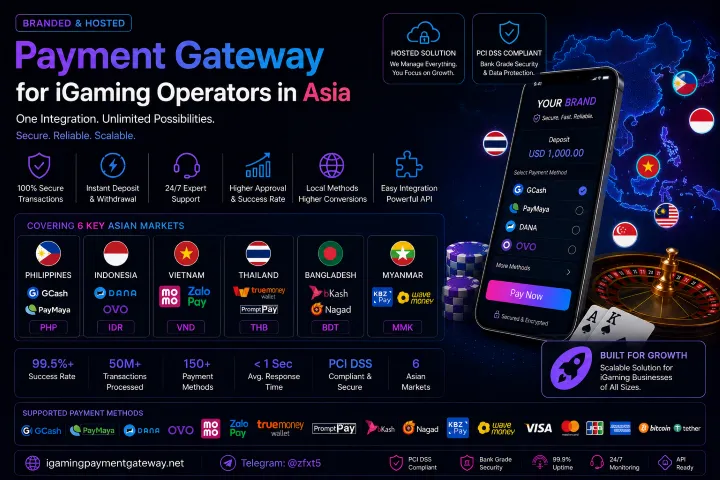
Payment Gateway for iGaming Operators in Asia | Branded, Hosted: Run It Where Your Players Are, Not Where Your Vendor Happens To Be
A payment gateway for iGaming operators in Asia isn't just about which rails you support or whose brand sits on the cashier. It's also about where the cashier physically runs. Most operator-facing pitches quietly skip this conversation — and operators quietly accept a latency tax their players feel on every single deposit. This page is about the difference between a branded, hosted-in-Asia gateway and a branded cashier hosted somewhere your players never go.
"Branded" and "Hosted" in the same keyword aren't redundant marketing language. They are two distinct architectural decisions. Brand identity is what your player sees. Hosting is where the bits actually live, and how quickly they travel between your player's phone and the wallet behind the curtain. Asian iGaming operators who optimise one without the other consistently end up with a polished-looking funnel that loses deposits for reasons their dashboards don't directly surface.
The Latency Tax No One Lists on the Invoice
The clearest way to understand the cost of getting hosting wrong is to compare round-trip times. A deposit involves a real conversation across the network: cashier → gateway → PSP / wallet → bank → callback → cashier. Every leg has physical latency. When the gateway is hosted in your players' region, those legs are cheap. When it isn't, they aren't.
You don't have to read those numbers as exact — the order of magnitude is the point. An Asia-hosted cashier feels like a local app. A Europe- or US-hosted cashier feels like a foreign-website checkout, and Asian iGaming players bounce on that feeling faster than survey data ever captures.
A Real Round-Trip Looks Like This
The latency tax doesn't show up as one number; it shows up as a chain of small added delays at every hop. Here is a sketch of what the cashier-to-bank-and-back round trip looks like when the gateway is hosted outside your players' region — the kind of trace your monitoring will not show you unless you go looking:
Nearly a full second on what should feel instant. Now do the same trace with the gateway hosted in-region: every long leg shortens, the TLS handshake is closer to the player, and the aggregate drops dramatically. Same UX, same code, completely different player experience.
What Latency Actually Breaks for the Player
Players don't say "your latency is 920ms." They say "the deposit didn't work," "is this thing frozen," "I'll try later." The cascade from infrastructure-layer milliseconds to operator-layer revenue looks like this:
The Latency Budget for "Instant"
"Instant" is a perceptual budget, not a number. Anything under roughly 300–400 milliseconds feels immediate; anything over a second feels broken. A deposit involves at least six conversational legs, so every leg has a strict budget. Hosting in-region keeps each leg cheap; hosting out-of-region blows the budget at the first hop.
One column fits inside "instant." The other does not. Same code, same player, same wallet — just different hosting.
Hosting Decides More Than Latency
Latency is the most visible cost of getting hosted wrong, but it's not the only one. Several other dimensions of running a real Asian iGaming gateway also collapse to where it physically lives:
Where payment data sits matters legally
Several Asian markets have evolving expectations about where personal and financial data is stored. Hosting in-region is the cleaner default; relying on a vendor that doesn't think about residency at all is an unforced legal risk.
Threats hit you from where you live
iGaming sites get probed and attacked far more than e-commerce sites. Regional edge protection in the same hosting environment your traffic actually traverses is materially more effective than a single far-away scrubbing centre.
Failover only helps if it's also near players
"We have a failover region" doesn't help if both primary and failover are far from your players. In-region primary + nearby failover keeps your cashier responsive even during a regional incident.
Your operations team has to reach the box
Debugging a production issue requires real-time access to the running system. An Asia-hosted gateway with an Asia-aware ops rotation closes the loop faster than a setup where every escalation crosses time zones.
What "Branded, Hosted" Actually Looks Like Together
"Branded" without "Hosted" gets you a beautiful slow checkout. "Hosted" without "Branded" gets you a fast checkout under someone else's name. Both are losing strategies for an Asian iGaming operator. The combination is the only configuration that works:
The Operator's Branded-Hosted Checklist
Why This Page Skips the PSP Conversation
The PSP angle lives elsewhere on this site, deliberately
Several of our other pages talk to operators and PSPs in the same breath. This one doesn't — by design. The branded-hosted argument hits hardest from the operator perspective, because operators are the ones whose players directly experience the latency tax. PSPs reselling rails downstream care about hosting too, but the lens is different and gets its own treatment elsewhere.
For the operator-side framing of brand sovereignty in detail — domain ownership, merchant account control, what "branded" actually means structurally — see our dedicated branded payment gateway for gaming operators article. The hosting story you've just read sits on top of that brand foundation, not next to it.
"Hosted" vs "Managed" — Two Sides of One Coin
It's worth being precise about the relationship between this page and our managed payment infrastructure page. Managed answers "who operates this thing?" (we do — provisioning, security, on-call, development). Hosted answers "where does it actually run?" (in your players' region). They are complementary and arrive together in our service, but they are conceptually distinct decisions — and operators evaluating gateways should ask both questions, not just one.
Everything Else, Compressed
Scope of this article: The branded-and-hosted lens specifically — where your Asian iGaming cashier runs, why that matters, and how operators (not PSPs) should think about it.
Pricing: Flat monthly hosting fee + 0.1–0.4% transaction volume share — hosting in-region is part of the standard package, not a premium add-on.
What you bring: brand, domain, merchant accounts, customer relationships. What we run: the regionally hosted gateway, monitoring, on-call rotation calibrated to Asian timezones, backups, failover and security.
Hosting-Specific Questions Operators Actually Ask
Can I just put a CDN in front of a far-hosted gateway and get the same effect?
No. A CDN helps with static assets, but a payment cashier's interactive request/response cycle still has to reach the gateway origin. Latency on the origin path is the part players actually feel, and a CDN doesn't shorten it.
How can I tell where my current gateway is hosted?
Run a basic traceroute or a TLS handshake timing test from a phone on a typical Asian mobile network. If the cashier endpoint hits servers more than two or three hundred milliseconds away, it isn't in your players' region. Vendors who don't openly disclose hosting region are usually disclosing it through that delay.
Does in-region hosting cost more than far hosting?
Not in our pricing model. In-region is the default, included in the flat monthly hosting fee. "We charge extra for regional hosting" is a structure we don't run, on the grounds that hosting where your players are isn't a premium — it's just the right place to host.
What about latency between us, the operator, and the gateway?
Your operator dashboard and back-office can be accessed from anywhere — its latency is far less player-impacting. The hosting argument is specifically about the player-cashier-wallet round trip, which is where milliseconds turn into deposits.
How does in-region hosting interact with the regulatory environment?
Cleanly. Several Asian jurisdictions have evolving expectations around where personal and payment data is stored. In-region hosting respects those expectations by default rather than requiring case-by-case carve-outs — though specific compliance requirements still belong in a scoping call rather than a public page.
What happens if there's a regional infrastructure issue?
Failover regions are also in-region — usually a nearby Asian zone rather than a continent away. That keeps the latency profile sane even during a regional incident. The whole point of regional hosting is that resilience and proximity aren't a trade-off; they reinforce each other.
Is "hosted" the same as "private"?
Related but not identical. "Hosted" describes the physical location of the infrastructure. "Private" describes whether your traffic shares that infrastructure with other tenants. A serious branded gateway gives you both — regionally hosted and architecturally private.
The Next Step
A working payment gateway for iGaming operators in Asia isn't one decision; it's at least three converging ones: the brand surface, the rails behind it, and the physical location where the infrastructure runs. Operators who treat hosting as an afterthought end up paying for it in latency, in retention, and in regulatory drift over time. The honest fix is to insist on Asia-hosted from the start.
Tell us which Asian markets you operate in, what your current gateway looks like, and where it actually runs today. We will scope a branded, regionally hosted alternative around your specifics and price it transparently. No CDN-fronted shortcuts.
Branded surface. Asian rails. In-region hosting.
The three decisions that decide whether your Asian funnel actually converts.
Talk About Hosting →