
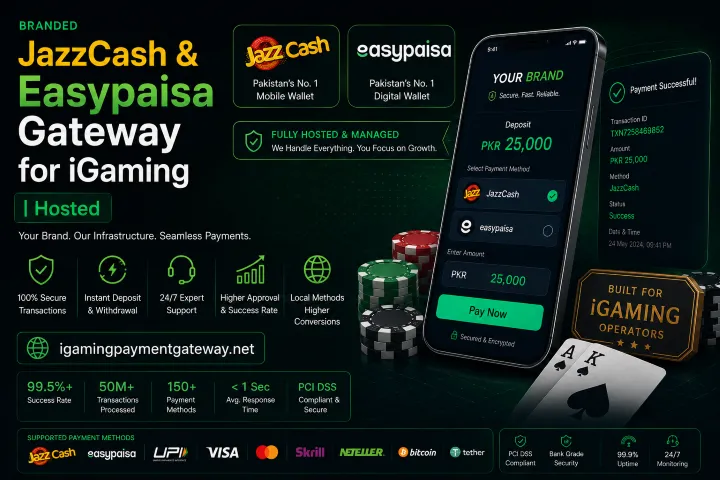
JazzCash and Easypaisa Payment Gateway: The Two-Wallet Stack for Casino & iGaming in Pakistan
A JazzCash and Easypaisa payment gateway isn't one integration — it's two, running in parallel, because Pakistan is structurally a dual-wallet market. The half of your players who live inside JazzCash will not switch to Easypaisa to deposit on your platform, and vice versa. Supporting one means losing the other. This page is about what dual-wallet actually requires, technically and operationally, for casino and iGaming traffic.
Every operator entering Pakistan has the same intuition at first: "we'll add one wallet, see how it goes, add the other later." That decision quietly forfeits roughly half of the addressable market on day one. The fix is structural, not incremental.
Pakistan Is a Dual-Wallet Market by Default
The Pakistani digital wallet landscape has two clear giants: JazzCash (operated under the Jazz telecom group) and Easypaisa (operated under Telenor Pakistan together with Easypaisa Bank). Players sort themselves between the two largely by carrier history, hometown, and family habits — and they stick. A Jazz subscriber sets up JazzCash because it's the path of least resistance on their phone; an Easypaisa user does the inverse. Asking either group to switch wallets just to deposit on your platform is asking them to do work no other operator asks them to do.
JazzCash and Easypaisa, Side by Side
The two wallets look similar from a Western perspective — "Pakistani mobile money apps" — but they have meaningfully different cashier behaviour, KYC flows, and operational personalities. Treating them as a single integration is exactly what produces the failure modes operators show up with later.
- Strongest in regions with Jazz mobile penetration
- Heavy agent and retailer cash-in network
- Familiar to the "wallet-first" user demographic
- Pairs wallet UX with a fully licensed banking layer
- Strong in markets with Telenor mobile share
- Familiar to users who already bank with Easypaisa
The Differences That Actually Matter at Integration Time
Below the surface, the two wallets diverge in the places that matter most for an iGaming cashier — flow type, callback behaviour, payout characteristics. The integration choices made on each side ripple into player experience for years.
| Dimension | JazzCash | Easypaisa |
|---|---|---|
| Operating entity | Jazz (telecom group) | Telenor Pakistan + Easypaisa Bank |
| Typical deposit flow | Wallet push / MPIN confirm | Wallet or bank-account flow with MPIN / OTP |
| Cash-in / cash-out network | Wide agent network | Wide retail + bank-branch network |
| Player segment lean | Telco-wallet-native users | Banking-comfortable users |
| Best-fit primary use | Quick small deposits | Larger or bank-anchored deposits |
| Payout / withdrawal | Back to the same wallet handle | Back to wallet or linked bank account |
| Operational personality | Mobile-first, agent-rich | Hybrid wallet-and-bank |
The Carrier-Banking Stack Behind Each Wallet
One reason these two wallets behave differently is that they sit on top of different ecosystems. JazzCash's roots are in mobile telecom; Easypaisa's roots are telecom layered onto a regulated banking entity. Both are real money rails, but the stack underneath shapes how they handle compliance, limits and payouts:
The practical consequence: an integration designed only for "Pakistani mobile wallets" almost always optimises for one of the two and misfires on the other. Each side has its own onboarding, dispute, and payout norms.
Both, or Bust
Pakistani operator-side math comes down to a simple set of scenarios. Whichever single wallet you skip is a wedge cut directly out of your conversion funnel — and not a thin one.
5 Operational Differences That Force Dual Engineering
Treating JazzCash and Easypaisa as "two checkboxes on a list" misses the engineering reality. Each wallet needs its own integration discipline, and the difference shows up across at least five operational dimensions:
Separate merchant onboarding for each wallet
The merchant relationship behind JazzCash and Easypaisa is established through different counterparties, with different document requirements and different verification timelines. Bundling them into one onboarding workflow doesn't shorten the actual elapsed time.
Distinct status callbacks and reconciliation files
Each wallet pushes status updates in its own format and cadence. Your gateway needs to normalise both into a single source of truth before settlement reports become readable.
Different MPIN / OTP flows on the player side
JazzCash and Easypaisa each have their own confirmation patterns. The cashier needs branch-aware copy so the player isn't following the wrong instructions for the wallet they actually picked.
Payout asymmetries on the way back
Withdrawals to JazzCash and Easypaisa do not follow the same rails. The payout module needs to handle both correctly, including different settlement times and different rejection patterns.
Independent failure modes
When one of the two wallets has a partner outage or policy tightening, the other usually still works. A properly built dual-wallet cashier degrades gracefully — it doesn't take down the whole Pakistani funnel just because one rail is having a bad day.
Casino & iGaming Traffic on These Two Wallets
Pakistani iGaming traffic carries a tempo similar to its regional neighbours — late-night peaks, mobile-first, multiple deposits per session, instant-gratification expectations. The dual-wallet wrinkle adds one extra dimension: the wallet a player picked the first time becomes their default forever. Your cashier needs to remember that, surface it on return visits, and not push them toward the wallet they didn't choose. For the broader Indian-market context where a single dominant rail (UPI) handles the same job, see our sister article on UPI payment gateway for casino & iGaming; the contrast between one-wallet and two-wallet markets is the clearest single insight you can carry into market planning.
Everything Else, Compressed
Pricing, supported markets beyond Pakistan, the managed-infrastructure breakdown and the customer-type personas live on the main service page so we don't repeat them here. The short version:
Scope of this article: JazzCash + Easypaisa as a dual-rail Pakistani stack for casino & iGaming. Other regional markets are out of scope and covered separately.
Pricing: Flat monthly hosting fee + 0.1–0.4% transaction volume share — applied identically across both wallets, no per-rail premium.
What you bring: merchant relationships on each wallet, or the willingness to set them up with our guidance. What we run: the dual integration, callbacks, reconciliation, payouts, monitoring and 24/7 ops.
Full pricing, market list, onboarding flow and customer-type personas are detailed elsewhere on this site — links at the end of this page.
Don't ship one wallet and lose the other half.
Get a managed JazzCash + Easypaisa scope built around your Pakistani player base.
Scope Pakistan Coverage →JazzCash & Easypaisa Specific Questions
Can I really not just start with one wallet and add the other later?
You can — and many operators do — but the loss isn't deferred, it's compounded. Players who tried to deposit and couldn't almost never come back when you finally add the other rail. Better to launch dual on day one.
Are JazzCash and Easypaisa interchangeable from a gateway perspective?
No. Same country, similar player base, structurally different rails. Merchant onboarding, callback formats, MPIN/OTP flows and payouts each have their own discipline. Treating them as one integration is the most common Pakistan-entry mistake.
What about other Pakistani rails — bank transfers, cards, raast?
JazzCash and Easypaisa cover the dominant wallet share; bank transfers and other rails play supporting roles. The right combination depends on your player profile, and we walk through the trade-offs during scoping rather than prescribe it generically.
How do withdrawals look across both wallets?
Withdrawals route back through the rail the player deposited on by default — JazzCash money returns to a JazzCash handle; Easypaisa money returns to a wallet or linked bank account. Players who try to mix rails get clear cashier feedback rather than silent failures.
Do I need a Pakistani entity to operate this?
The merchant-relationship layer depends on your operating model. The technology integration is structurally the same either way; the legal-structure question is part of scoping rather than something to resolve on a public page.
What happens if one wallet's policies tighten for high-risk verticals?
The other usually continues to operate, and players can complete deposits on whichever rail is healthy. A dual-wallet cashier is also a continuity hedge — single-rail operators discover the value of this only after their one rail has a bad week.
The Next Step
A working JazzCash and Easypaisa payment gateway doesn't come from picking one wallet and bolting the other on later. It comes from designing the Pakistani cashier as a dual-rail product from the first scoping call. The operators winning in Pakistan are the ones who took that decision seriously up front; the ones still losing players in their funnel are usually one wallet behind where they thought they were.
The next step is short. Tell us your expected Pakistani monthly volume, your target player profile, and whether you already hold merchant relationships on either wallet. We will scope a dual-wallet stack and price it transparently. Conversations are free.
Two wallets, one stack, one invoice.
Run the Pakistani market the way the Pakistani market actually works.
Talk to the Pakistan Team →