
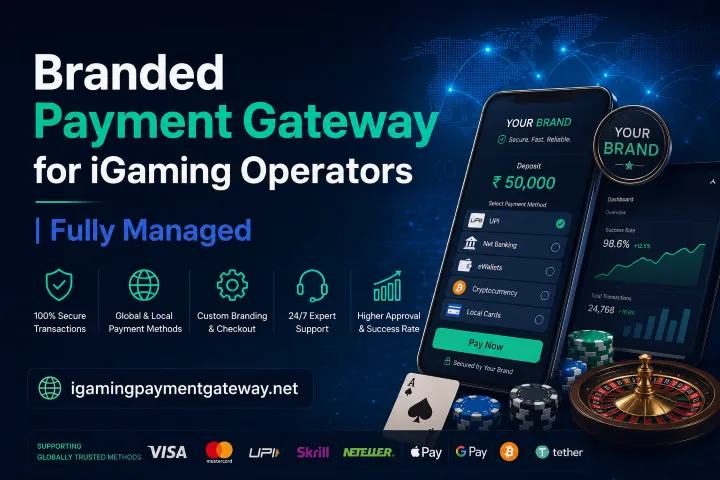
Branded Payment Gateway for Gaming Operators: When Your Cashier Wears Your Name, Not Theirs
A branded payment gateway for gaming operators means one specific thing: the cashier your players see lives on a domain you own, under a brand you control, plugged into merchant accounts that belong to you. Not a logo printed on someone else's checkout — a channel that is genuinely yours, top to bottom, with us operating the technology behind the curtain.
The rest of this page is about a single question: whose name is on the cashier when your player hits "deposit"? If the honest answer makes you uncomfortable, keep reading.
What "Branded" Is Not
The word "branded" gets stretched until it stops meaning anything. Most vendors claim it. Almost none of them deliver the real version. So before describing what we ship, the cleaner exercise is to name what doesn't count:
- Your logo on a vendor cashier — the URL bar still says
checkout.vendor.com/your-merchant-id. Players see whose platform it is the moment they click "deposit." That's not branding; that's a sticker. - A "white-label" page hosted by the vendor — your branding loads, but DNS, certificates, and the underlying service are theirs. The day they rebrand, your cashier blinks.
- A reseller sub-merchant slot — you're a row in their database. Your acquiring is their acquiring with a margin layered on top. The channel can be reassigned, throttled or closed at the parent vendor's discretion.
A true branded payment gateway flips every one of these: your domain in the URL bar, your infrastructure under the SSL certificate, your merchant accounts holding the funds. We're the engineers — but to the outside world, we are invisible.
What Your Players Actually See
Branding lives in the address bar before it lives anywhere else. Here is what a branded cashier built on our stack looks like to the player on the other end:
The address bar is the part players actually read. When a deposit hits pay.your-brand.com, the trust signal lands with your brand — not with a payments company they've never heard of. When a chargeback dispute opens, the bank sees your brand. When a competitor screenshots your cashier, they screenshot your brand. The compounding effect of every transaction is captured by you, not leaked to the gateway.
The Four Layers of Channel Sovereignty
"Owning your channel" is a phrase that needs unpacking. There are four distinct things you can own — and most operators only own one or two of them. A real branded gateway gives you all four:
Surface — Brand & UX
The cashier UI, admin panel, emails, receipts. Every player-facing surface carries your visual identity.
Address — Domain & SSL
The gateway runs on a domain you own. SSL certificates are issued to you. DNS is yours.
Funds — Merchant Accounts
Acquiring relationships and merchant accounts are in your company's name. Settlement flows to your bank, not into a vendor pool.
Future — Roadmap & Rules
You decide who you serve, what risk rules apply, which new methods to add. The vendor doesn't have a veto.
Vendor cashiers almost always give you Layer 1, sometimes Layer 2, rarely Layer 3, and never Layer 4. A branded gateway done properly delivers all four — and the deeper the layer, the harder it is to fake. That's the actual difference.
Who Holds the Levers — A Side-by-Side
Not abstract benefits — concrete levers. For each one, the only question is: when push comes to shove, whose hand is on it?
| Lever | Branded gateway (you) | Vendor cashier (them) |
|---|---|---|
| Choose which merchants/players to onboard | ✓ | ✗ |
| Decide the cashier UI & checkout flow | ✓ | ✗ |
| Set risk rules tuned to your business | ✓ | ✗ |
| Add or remove payment methods on demand | ✓ | ~ |
| Decide where settled funds land | ✓ | ✗ |
| Survive vendor policy changes | ✓ | ✗ |
| Keep the channel running if the operator changes | ✓ | ✗ |
The Two Pain Points That Force This Decision
Most operators don't shop for "branded" gateways out of vanity. They shop out of one of two specific moments that kill the rented model overnight. We hear these two over and over:
Before → After
Those are the two failure modes a branded gateway specifically eliminates. The other seven recurring pains — frozen cards, creeping commissions, gated terms, vendor risk control, missing transactions, instability, opaque cash flow — are covered in detail on the main iGaming Payment Gateway page if that's the angle you came for. This page stays focused on the branding/sovereignty angle.
Why This Page Speaks to Operators Specifically
Operators are the audience for whom the branded angle is sharpest, because operators are the ones whose players see the cashier. A platform's brand equity is built one deposit at a time — and every deposit that flashes through a vendor-branded checkout is brand equity leaked away.
The same managed gateway also works for PSPs reselling channels downstream, but the branding argument plays differently there: PSPs are usually selling their own brand to downstream operators rather than competing for player trust. If you're a PSP, the relevant page is the main iGaming Payment Gateway homepage; this article is built for the operator-side conversation.
Everything Else, In One Box
The shared facts about our service — supported countries, pricing model, onboarding timeline — are covered in depth on other pages so we don't repeat them here. The short version:
Coverage: 6 markets across South and Southeast Asia, with locally dominant rails pre-integrated.
Pricing: Flat monthly hosting fee + 0.1–0.4% transaction volume share. No reseller margin.
Onboarding: Scoping → branding/domain → provisioning → merchant accounts wired in → methods activated → go live with 24/7 operations.
What we run: servers, security, PCI DSS handling, ongoing development. What you keep: brand, domain, merchant accounts, customer relationships.
Let's put your brand in the URL bar.
Tell us your brand name and which markets you want live. We'll come back with a scoped launch plan.
Start the Brand Conversation →Questions Specific to the Branded Model
Can I bring an existing domain, or do I need a new one?
Both work. If you have a payments subdomain you've been wanting to use (e.g. pay.yourplatform.com), we configure DNS and SSL on it. If you'd rather use a separate brand domain for the cashier, we help you secure one and set it up from scratch.
Will players or auditors find out it's a third-party platform underneath?
Not from anything we render. There is no "powered by" footer, no vendor referral parameter, no third-party domain in the checkout flow. If you ever proactively disclose the technology partner (some operators do, for transparency), that's your decision — never forced from our side.
What happens to my branded gateway if I switch to a different platform vendor someday?
Your domain, your merchant accounts and your customer database remain yours. The branding doesn't have to break — at worst, it migrates. This is structurally different from a vendor cashier, where rebranding usually means a full re-onboarding of every player.
Can I customise the cashier UI beyond just colours and logos?
Yes. Layout changes, payment-method ordering, custom copy, region-specific cashier variations and brand-specific microcopy are all part of the ongoing development covered by the monthly fee.
Does "branded" mean I'm running my own PCI DSS scope?
No — and that's deliberate. The cashier wears your brand, but sensitive card data is processed under our PCI DSS scope, not yours. You get the branding upside without inheriting the compliance burden.
The Next Step
A branded payment gateway for gaming operators is not a marketing flourish — it is a structural decision about who owns the most valuable surface in your business. The cashier is where money meets brand meets trust. Putting someone else's name on it, even with your logo pasted on top, leaks all three.
If you operate a gaming platform and the conversation above sounds like a problem you've been quietly carrying, the next step is short: tell us your brand name, your target markets among the six we cover, and the merchant accounts you're bringing. We'll come back with a launch plan and a price — both transparent.
Your brand. Your domain. Your channel.
Run the gateway your players already think is yours.
Get a Branding Scope →