
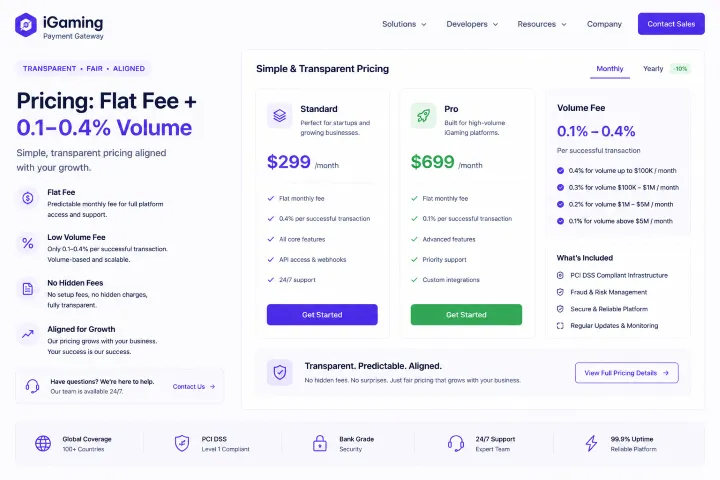
Pricing: Flat Fee + 0.1–0.4% Volume | Transparent, Aligned: Two Numbers, No Hidden Spread, No "Effective Rate" Surprises
Pricing for our managed iGaming payment gateway is two components: a flat monthly hosting fee, and a 0.1%–0.4% share of the transaction volume that flows through your stack. Both are published. Neither moves with volume in ways that surprise you. The reason we put the numbers on a page rather than behind a "contact us" form is that the alternative is the industry default — and the industry default is exactly what operators tell us they're tired of.
Most payment pricing pages don't exist. The "Contact us for custom pricing" page exists. The "Let's discuss your needs" page exists. The pricing page itself, with actual numbers, doesn't — because in payments, opacity is a feature for the vendor and a tax on the operator. This page runs the math, names what's included, names what isn't, and explains the alignment structure that decides whether a vendor and an operator are actually on the same side.
The Two Components, Both Visible
Monthly Hosting Fee
Volume Share
Sample Math at Different Volumes
The most useful thing a pricing page can do is run actual numbers. The illustration below uses a representative flat-fee scope; the exact figure is set at engagement. The point is the shape of the cost curve — predictable on the flat component, linear on the volume share, no inflection points where a higher tier suddenly multiplies your bill.
| Monthly Volume | Flat | Variable @ 0.25% | Monthly Total |
|---|---|---|---|
| $100,000 | flat | $250 | flat + $250 |
| $500,000 | flat | $1,250 | flat + $1,250 |
| $1,000,000 | flat | $2,500 | flat + $2,500 |
| $5,000,000 | flat | $12,500 | flat + $12,500 |
| $10,000,000 | flat | $25,000 | flat + $25,000 |
Notice what's not in this table: no tier thresholds, no surge pricing for peak windows, no per-method premiums (UPI deposits cost the same as bKash deposits cost the same as MoMo deposits, from our side), no per-tenant surcharge for PSPs running multiple downstream operators. The variable share scales linearly; the flat component does not move with volume at all.
What's Included — Versus What Other Pricing Models Charge Separately
The way to read a payment vendor's published price is to look at the list of things not in it. Most industry pricing has a long list of "additionally billable" items that arrive on invoices after the contract is signed. Our flat fee is genuinely inclusive — here is the head-to-head:
| Item | In Our Flat | Often Add-on |
|---|---|---|
| Branded cashier UI | ● | $$$ |
| Merchant admin & order management back-end | ● | $$$ |
| Payment API + webhooks + SDKs | ● | $$ |
| Pre-built local rail integrations (UPI, bKash, JazzCash, MoMo, GCash, KBZPay, Wave Money) | ● | $$$ |
| Domain setup, SSL certificates, CDN, TLS configuration | ● | $$ |
| Regional in-Asia hosting | ● | $$$ |
| 24/7 operations & on-call | ● | $$$ |
| Ongoing feature development | ● | $$$ |
| PCI DSS scope handling | ● | $$ |
| AML & sanctions screening | ● | $$ |
| Reconciliation & reporting | ● | $$ |
| Sandbox + production environments | ● | $ |
| Per-tenant provisioning (for PSPs) | ● | $$$ |
| Audit log + scope letter for compliance | ● | $ |
| Status page + incident notifications | ● | $ |
What's NOT in the Price — Stated Explicitly
A trustworthy pricing page also says what isn't included. The honest answer for our model is: the things that genuinely sit on the operator's side of the line, and a small handful of pass-through fees that aren't ours to charge or absorb. Specifically:
The honest exclusions
Anything not on the list above and not on the list below is in the flat + volume. There is no third pricing component hiding behind the contract.
The Industry-Standard Charges We Don't Have
Equally important is what we explicitly do not charge. These are charges that operators routinely find on competitor invoices but won't find on ours:
What's deliberately absent
Why the Structure Is Aligned (and Why That Matters)
The alignment is structural, not aspirational
The opposite alignment looks like this: a vendor charging per-API-call regardless of approval rate gets paid whether your deposits succeed or fail. A vendor inserting a hidden reseller margin gets paid more when your acquirer charges you more. A vendor with a "platform fee" decoupled from your revenue gets paid the same whether you grow or stagnate. Our model deliberately doesn't do any of those. We earn more when — and only when — you do.
Total Cost of Ownership — Three Scenarios Compared
The real comparison isn't sticker price between vendors; it's all-in cost of getting to a working Asian iGaming payment stack. The honest three-way comparison:
DIY Build
Typical reseller PSP
Our managed model
Option A trades a long timeline and ongoing operational cost for full ownership. Option B trades opacity for simplicity. Option C is the trade we've structured: a flat fee for the predictable operational layer plus a transparent volume share for the variable layer, and a list of explicitly-absent industry charges that operators discover only after they've signed elsewhere.
Payment Mechanics — Billing & Cycle
Where Pricing Sits in the Bigger Picture
The flat-fee component covers the entire stack described elsewhere on this site — the cashier, the admin, the API, the operations, the hosting, the compliance handling. Our managed payment infrastructure article walks through what's actually being run on your behalf for that flat number. The PSP-specific economics — where you charge your own downstream operators and the spread is your margin — are described in our payment infrastructure for PSPs in Asia | turnkey, branded article. The price you see on this page is the wholesale cost behind both.
Everything Else, Compressed
Two-component pricing: flat monthly hosting fee + 0.1–0.4% transaction volume share. No third term, no hidden spread, no surge pricing, no per-method premium, no per-tenant surcharge for PSPs.
Aligned by construction: the only variable component is tied directly to your transaction volume. When you grow, we grow with you. There is no incentive on our side that competes with yours.
The published number is the actual number. Exact flat figure is scoped per engagement and depends on volume profile and market mix; the structure is the structure on the page.
Pricing that doesn't require translation after the contract.
Two components on the page. Same two components on the invoice. The math doesn't change between them.
Request a Pricing Scope →Pricing-Specific Questions
What determines whether my volume share rate is 0.1%, 0.4%, or somewhere in between?
Three inputs: expected monthly volume, market mix (some Asian markets have higher rail costs on our side than others), and contract duration. Higher volumes and longer engagements tend toward the lower end of the range; the exact rate is locked at engagement and doesn't ratchet up over time.
Does the flat fee scale with markets or transactions?
The flat fee is set at the scope of your engagement — number of markets, complexity of your tenant model (single operator vs PSP with multiple downstream), feature scope. It doesn't tick up with transaction count or volume; that's what the variable share is for. Adding a new market in the same engagement is a configuration step, not a pricing step.
What if I'm a PSP with many downstream operators?
The flat fee covers the platform; the volume share applies across the aggregate of your downstream traffic. The price you charge each downstream is your decision and your margin. We don't charge per-tenant; we don't take a cut of your downstream pricing.
Are there volume tiers where the rate changes step-wise?
No step changes. The rate set at engagement applies linearly across the whole volume range it covers. Operators dislike step pricing because it creates incentives to game thresholds; we deliberately don't use it.
What's the typical engagement duration?
Annual is common; multi-year is possible with rate concessions reflecting the commitment. We don't lock customers into long terms as a defensive moat — the structural argument for staying is that the service is good, not that the exit is expensive.
Can I get a written breakdown for procurement?
Yes. The engagement document spells out the flat figure, the volume share rate, the scope of what's covered, the explicit list of exclusions, and the billing cycle. Procurement teams reviewing it should find everything on this page reflected in formal contract language.
What happens if my traffic spikes massively in a single month — say a tournament event?
The volume share scales with volume; that's the design. There's no surge pricing or peak multiplier. A 5× traffic month produces a 5× variable invoice (still at the same rate); the flat component doesn't move. Predictable up; predictable down.
The Next Step
A working pricing model for an iGaming payment gateway looks like the page you just read: two components, both published, both auditable, both structurally aligned with the operator's growth. The 7-article series this page closes was a deliberate attempt to disclose everything that usually sits behind a sales conversation — the cashier UI, the admin back-end, the API, the domain setup, the compliance posture, the operations rhythm, and now the price.
Tell us your expected monthly volume, your target Asian markets, and your operating model (operator, PSP, channel reseller). We will return a fully-scoped engagement: the flat figure, the volume share rate, the contract scope, and a representative invoice format — all within a single working conversation, no procurement choreography.
The published price is the actual price.
Flat + 0.1–0.4% volume. Inclusive. Aligned. Inspectable line by line.
Get My Exact Scoping →