
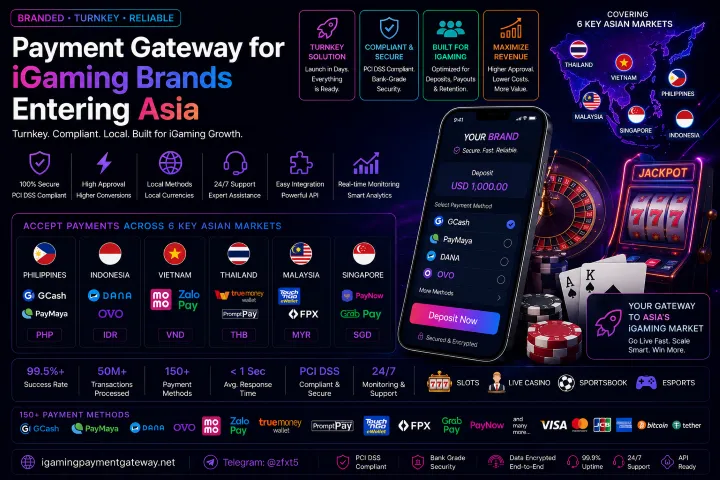
Payment Gateway for iGaming Brands Entering Asia | Turnkey: What Most Western Operators Discover About Asia After They've Already Lost the First 90 Days
A payment gateway for iGaming brands entering Asia is fundamentally different from "adding a few new methods to the gateway you already have." Asia is its own technical, operational, and cultural rule set — and the brands that try to retrofit a European or US-built gateway for Asian players consistently underestimate every dimension of the gap. A turnkey Asia-entry stack collapses that learning curve into a configured deployment, so you stop discovering the rules by failing to follow them.
Every Western iGaming operator who has entered Asia tells some version of the same story. The first plan was: "we'll just add UPI and bKash to our existing gateway." The second plan, three months later, was: "we need to actually understand what we're doing here." The third plan, often a year in, was: "we should have started with an Asia-native stack from day one." This page is the third plan, written down before you have to make the first two.
Day-0 Assumptions vs Asian Reality
Brands entering Asia carry a set of assumptions from their home market. Most of them aren't wrong on principle — they're just inapplicable to the actual conditions in Asia. The honest pattern of mistakes is consistent enough to write down up front:
The DIY Asia-Entry Timeline vs the Turnkey One
Brands have two genuine paths into Asia: discover the rules the slow way (build it yourself, learn from failures) or import the rules ready-applied (deploy a turnkey Asia stack on day one). The visible difference shows up across the first three to twelve months:
Your Existing Stack vs an Asia-Native Stack
The temptation when entering Asia is to ask "how much of our existing stack carries over?" The honest answer: some pieces do, more pieces don't, and the ones that don't tend to be the ones players actually touch. A direct comparison of the major dimensions:
| Dimension | Western iGaming Stack | Asia-Native Stack |
|---|---|---|
| Dominant rails | Cards, bank transfers, regional e-wallets | UPI, bKash, JazzCash, MoMo, GCash, KBZPay, Wave Money — local wallets first |
| Player identifier | Card number / email | Mobile number / VPA / wallet handle |
| Currency & formatting | EUR / GBP / USD | INR, PKR, BDT, VND, PHP, MMK with local separator and amount conventions |
| Risk tuning | European fraud patterns | Asian deposit-velocity-tolerant; cricket-toss spikes; in-play tempo |
| Peak windows | Sat–Sun evening Europe | Fri–Sat in BD; cricket events in IN/PK/BD; football late nights region-wide |
| Language & script | English / European languages | Burmese, Vietnamese, Bangla, Urdu, plus English; correct script rendering |
| Hosting location | Europe / US data centres | Asia-hosted — latency to Asian players is in-region, not transcontinental |
| Merchant relationships | Western acquirers | Local PSPs and wallet merchants in each Asian country |
The cleanest read on the table: about 60–70% of an Asia-facing stack genuinely differs from a Western one. Trying to patch the difference incrementally is how operators end up nine months in with a brittle hybrid neither team understands.
The Moment That Tells You Whether the Stack Works
The first Asian player who completes a deposit on your cashier is the moment that tells you whether the stack works. They don't read your marketing. They tap deposit, choose UPI or whichever local rail they actually use, expect the cashier to feel native, and decide in seconds whether they trust your brand enough to do it again next time:
Either it feels like it was made for them or it doesn't. The verdict is rendered immediately.
Brands that pass this test convert and retain. Brands that don't usually never get the player back to find out why. There is no second chance to look native; the first attempt is the only one that matters.
The Risks of DIY Asian Entry, Counted in Months
The DIY path isn't theoretical — it has a concrete cost structure that compounds month by month. These are the milestones brands typically hit when they try to enter Asia by extending a non-Asian gateway:
What "Turnkey Asia Entry" Actually Compresses
The alternative path replaces the slow learning curve with a configured deployment. Same final destination, dramatically faster path — and crucially, you keep the year of player retention that DIY would have spent on learning:
The deeper context for what you're actually entering — the six markets, their rails, their player rhythms, their language and weekend calendars — sits on our iGaming payment gateway across 6 Asian markets regional atlas. Once you're operating in-region rather than entering, the deeper conversation about hosting and operator-side latency lives on our dedicated payment gateway for iGaming operators in Asia page.
Everything Else, Compressed
Scope of this article: The market-entry lens specifically — what Western and other non-Asian iGaming brands need to understand about Asian payment infrastructure before they spend a year discovering it the hard way, and how a turnkey stack collapses that discovery into weeks.
Pricing: Flat monthly hosting fee + 0.1–0.4% transaction volume share — applied uniformly across all six Asian markets. No per-country setup surcharge for first-time entrants.
What you bring: your iGaming brand, target market priorities, willingness to engage on local merchant relationships. What we run: the full Asia-native stack — local rails pre-integrated, risk tuned to regional traffic, hosting in-region, ops on Asian calendars.
Skip the lost year. Land in Asia ready.
Turnkey Asian payment infrastructure for brands entering the region for the first time.
Plan My Asia Entry →Asia-Entry Specific Questions
We already have a working gateway in our home market. Can we just bolt Asia on?
You can — and many brands try — but the parts that need to change for Asia are usually the parts that touch the player. Bolting on while keeping a Western-built cashier shell means players in Asia experience a slightly off-feeling checkout, and the most expensive cost of that is invisible: the players who don't come back.
Do we need to enter all six markets at once?
No — and most brands don't. Most start with one or two priority markets and add the others as they scale. The point of the turnkey stack is that adding new markets is configuration rather than rebuild, so you don't get locked into your first two for the wrong reasons.
What about merchant accounts? Do we need to set up local entities everywhere?
The merchant-relationship layer depends on your operating model. The technology side is structurally the same either way; legal-structure decisions belong in scoping rather than a public answer. Brands entering Asia usually combine bring-your-own merchant relationships in some markets with our help establishing them in others.
How does pricing compare to keeping our existing gateway and extending it?
The straight cost of the turnkey stack — flat monthly + 0.1–0.4% volume share — is usually competitive against the all-in cost of DIY extension when you honestly account for the engineering hires, the merchant-account legwork, and the months of lost player acquisition during build. The hidden line items are where DIY entries get expensive.
Can our European players still use the same gateway, or is this an Asia-only thing?
Most brands keep their existing gateway for home markets and route Asian players to the Asia-native stack. The brand is consistent across both; the underlying infrastructure is tuned for the player's region. Forcing one stack to serve both ends up serving neither well.
What's the realistic time from signed contract to first real Asian deposit?
Weeks, not months — typically inside a month for the first market when the brand is decisive on scoping and bringing or brokering merchant accounts cleanly. Adding subsequent markets is faster still.
How do we know we're getting Asia-native and not just Asia-translated?
The proof is in the cashier. A native cashier renders amounts in local conventions, surfaces local wallets first, respects local weekend calendars in its operations, and uses script and language correctly without obvious translation seams. Brands evaluating gateways should ask to see exactly what a player in India or Bangladesh would actually see — not what a back-office translated screenshot looks like.
The Next Step
A working payment gateway for iGaming brands entering Asia is not a project plan; it's a configured deployment. The brands that win Asia are the ones who imported the rules ready-applied and started building player relationships from day one. The brands that lose Asia are the ones who tried to discover the rules by violating them. The compressed timeline above isn't a marketing promise — it's an honest accounting of how long it takes to land in a market when you stop trying to retrofit your home-market stack.
Tell us where you operate today, which Asian markets are your priority, and what your existing brand looks like outside the region. We will scope a turnkey Asia-entry stack around your specifics and price it transparently — and you'll know within a single conversation whether the timeline above is achievable for your situation.
Don't enter Asia twice — once badly, once right.
The Asia-native stack that lets you land it right the first time.
Talk About Asia Entry →