
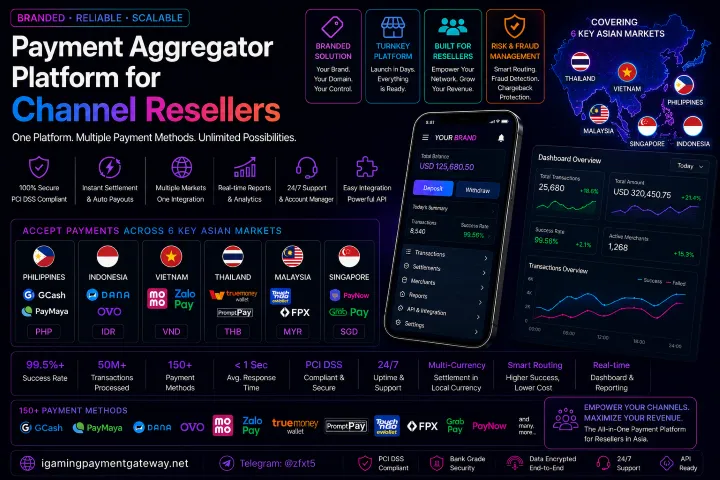
Payment Aggregator Platform for Channel Resellers | Branded: Take the Channels You Already Have. Turn Them Into a Product Your Customers Buy.
A payment aggregator platform for channel resellers is the system that does one specific job: it takes the payment channels you already control and turns them into a coherent, branded, sellable product. Channel resellers don't need new channels. They need the platform that aggregates the channels they have, normalises them into one consistent interface, brands the surface as theirs, and delivers it as a product to their downstream merchants and operators.
If you're a channel reseller reading this, you already have what most companies in this conversation don't: actual payment channels. Real acquiring relationships. Real wallet merchant identities. Real connections to banks and PSPs across Asian markets. What you don't have — what nobody hands you as a packaged product — is the aggregator system that takes those raw inputs and makes them sellable. This page is about that system.
The Aggregator Sits in the Middle of a Funnel
The structure of a channel reseller business looks like a funnel: you have multiple channel sources on the inbound side, you need a single coherent product on the outbound side, and the aggregator platform is the conversion machinery in the middle. Without it, you have a pile of disconnected relationships. With it, you have a product.
Why Normalisation Is the Unglamorous Heart of an Aggregator
Channels you bring into an aggregator don't speak the same language. One acquirer's response codes are different from another's. One wallet's callback format isn't the same as the next. One PSP's reconciliation file uses CSV columns nobody else uses. The job of the aggregator platform is to take all those inbound formats and produce one outbound format your downstream customers can build against.
{ "txn_id":"ABC", "rc":"00", "amt":"1500" }
{ id, status:"approved", amount:1500.00 }
{ "ref":"xyz", "state":"S", "value":1500 }
{ id, status:"approved", amount:1500.00 }
{ "transactionId":"q1", "success":true, "amountInPaise":150000 }
{ id, status:"approved", amount:1500.00 }
This sounds like minor plumbing until you've tried to build it yourself. It is genuinely the unglamorous heart of every aggregator platform — and the reason channel resellers who try to build their own usually stall here.
What You Bring vs What the Platform Adds
The cleanest way to understand whether the aggregator model fits your business is to map what you'd contribute against what the platform contributes. The deal works when both sides bring something the other can't easily duplicate:
The channels and the customer relationships
- Existing acquiring relationships
- Wallet merchant identities you've already set up
- Bank rail connections and PSP partnerships
- Downstream merchants and operators who already trust you
- Business judgement about which deals are worth onboarding
- The pricing you charge your downstreams
The aggregator platform and the heavy engineering
- Multi-tenant infrastructure and branded surfaces per downstream
- Pre-built integrations to UPI, bKash, JazzCash, MoMo, GCash, Wave, etc.
- Normalisation layer across all channel formats
- Smart routing engine across your channels and ours
- Reconciliation, monitoring, 24/7 operations
- Per-tenant analytics + aggregate roll-up for your finance team
Routing Logic: How the Aggregator Picks Which Channel Carries the Transaction
An aggregator without routing logic is just a list. The platform's job is to take an incoming transaction from a downstream and decide — in milliseconds — which of your channels (or our pre-built rails) should carry it, based on the actual conditions in play. Simplified, the decision flow looks like this:
This is the part of the platform that genuinely earns its keep. A well-designed routing engine increases approval rates without anyone on your side pressing a button — and it does it across your channels and ours interchangeably.
Channel Health, At a Glance
An aggregator without observability is a black box. The platform surfaces a real-time view of every channel's current health — yours and ours, side by side. When something degrades, you see it before your downstream customers start complaining:
"Aggregator Platform" vs the Broader PSP Stack — How to Read the Difference
We have a closely related page on payment infrastructure for PSPs in Asia | turnkey, branded, which addresses PSPs from the speed-to-tenant and unit-economics angle. The aggregator framing on this page is narrower and more technical. The honest distinction:
Two complementary lenses on the same managed core
| Lens | PSP / Turnkey page | Aggregator (this page) |
|---|---|---|
| Question answered | "How fast can I stand up a new tenant?" | "How do I unify the channels I already have?" |
| Mental model | Business / sales velocity | Technical / channel mechanics |
| Primary value | Speed-to-tenant + margin per tenant | Normalisation + smart routing across channels |
| Best fit | PSPs growing their downstream operator count | Channel resellers turning existing channels into one product |
Both pages describe the same managed platform from different angles. Whichever framing feels closer to your immediate question is the one to start from; the other is the natural next reading.
"Branded" Specifically for Channel Resellers
The "Branded" modifier in this keyword has a specific meaning that's worth being precise about. For a channel reseller, branding works at two distinct layers:
- Layer 1 — Your own brand at the platform level. The aggregator console you operate, the dashboards you use, the documentation you hand to downstream technical teams — all of that wears your name, not ours. To your customers, you're the platform.
- Layer 2 — Each downstream customer's brand at the cashier level. When you provision a new operator on your platform, their player-facing cashier wears their brand, on their domain, with their merchant display strings — not yours, not ours.
The structural framing of what "branded" means in the deeper sovereignty sense — domain, merchant accounts, control surfaces — is detailed in our branded payment gateway for gaming operators article. The two-layer pattern above is the channel-reseller-specific extension of those principles.
Everything Else, Compressed
Scope of this article: The aggregator-platform lens specifically — the technical mechanism by which channel resellers pool their existing channels with our pre-built integrations, normalise them, route intelligently, and present one branded product to downstream customers.
Pricing: Flat monthly hosting fee + 0.1–0.4% transaction volume share. No reseller margin layered on top; the spread between your wholesale rate with us and the price you charge downstream is your margin to keep.
What you bring: existing channels, downstream customer relationships, your own brand. What we run: the aggregator platform, normalisation layer, routing engine, observability, 24/7 operations.
Stop selling channels as a pile. Sell them as a platform.
The aggregator your resale business should already be running on.
Talk About the Aggregator Stack →Channel-Reseller Specific Questions
Do I have to use your pre-built integrations, or can I just use my own channels?
Both. You can run the aggregator purely on your own channels if that's your model, or you can mix in our pre-built integrations (UPI, bKash, JazzCash, MoMo, GCash, Wave, etc.) to extend coverage without onboarding new merchants. Most channel resellers end up doing the mix because the marginal cost of adding a pre-built rail is low.
Can I add a new channel later as my business grows?
Yes. Adding a new channel to your aggregator is a configuration step — provide the credentials and routing rules, and the new channel slots into the normalisation and routing engine. You don't have to rebuild your platform every time you add an acquirer.
How does the routing engine decide between my channel and your pre-built one?
By the rules you set, weighted by real-time health metrics. You can prefer your own channels when both are healthy, fall back to pre-built when yours degrade, or run any other policy you prefer. The routing engine is configurable, not opaque.
Do my downstream customers know my channels from your channels?
Not unless you choose to expose that. From the downstream's perspective, every transaction is a request to "your platform" and a response from "your platform." The fact that some routes hit your acquirer and some hit our pre-built integrations is your operational reality, not theirs.
How do reconciliation files work when transactions go through multiple channel sources?
The platform produces one normalised reconciliation feed per downstream customer, plus an aggregator-wide view for your finance team that shows which underlying channel carried each transaction. You see both the unified outbound and the granular inbound.
What happens if one of my own channels suddenly stops working?
The routing engine detects the health degradation in near-real time and shifts traffic to the next-best available channel automatically. Your downstream customers experience normal transaction flow; you get an alert on the dashboard. The fix on the underlying channel relationship is between you and that channel partner, not us.
How is this different from running multiple gateway integrations in parallel myself?
Doing it yourself means N integration codebases, N reconciliation formats, N response-shape normalisations, and N monitoring contexts to keep healthy — plus the routing engine you'd have to build on top. An aggregator platform replaces all of that with one consistent surface that you operate as a branded product.
The Next Step
A working payment aggregator platform for channel resellers isn't a gateway in the conventional sense. It's a normalisation and routing layer that turns a collection of independently-acquired channels into a single, branded, sellable product. Channel resellers who get this right operate a platform business with compounding economics; channel resellers who don't end up with a pile of disconnected integrations that get progressively harder to maintain.
Tell us what channels you currently hold, which Asian markets your downstream customers care about, and how you want your aggregator to look from the outside. We will scope a branded aggregator platform around your specifics and price it transparently — and the channels you bring stay yours.
Your channels. Your brand. One platform.
The aggregator that turns reseller inventory into a real product.
Scope My Aggregator Platform →