
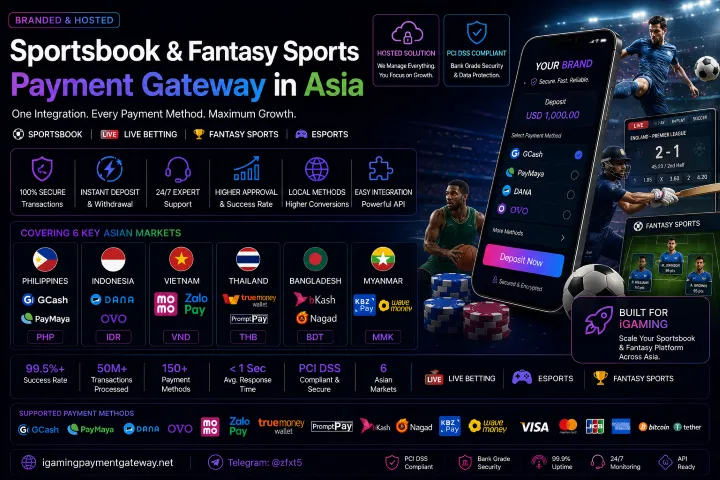
Sportsbook & Fantasy Sports Payment Gateway in Asia | Branded: When the Toss Lands and the Whole Cashier Tries to Deposit at Once
A sportsbook and fantasy sports payment gateway in Asia isn't a cashier that runs evenly through the day. It's a cashier that has to absorb dramatic event-driven spikes — toss times, kickoffs, fantasy lineup locks — and keep your branded surface responsive while the world's sports calendar dumps thousands of deposits into the same five-minute window. Casino traffic flows like a tide. Sports traffic comes in storm fronts.
Most "payment gateways for sports betting" treat the cashier like any other. They aren't designed around the actual rhythm of the audience: the moment a big match is about to start, deposit demand multiplies; minutes later, in-play wagering rolls in with its own urgency; hours after settlement, withdrawal requests cluster around when players check whether their parlays cashed. A branded gateway worth the name is built for that rhythm, not against it.
The Cashier's Worst Five Minutes of the Day
Look at a normal day on a sportsbook cashier. The picture is calm — until it isn't. Volume hovers around a baseline, sometimes for hours, and then jumps to a multiple of that baseline in a window of minutes, then collapses back down. That window is when your gateway either holds or breaks. The shape looks something like this:
What happens during that red window decides whether your sportsbook earns its weekend revenue. A cashier that queues, lags, or times out under spike load doesn't just lose those deposits — it loses the trust of the players who experienced the lag. They remember next time.
Two Tempos in One Vertical: Pre-Match vs In-Play
Sportsbook traffic is actually two distinct cashier patterns running back-to-back. Pre-match is a build-up: deposits arriving over the hours and minutes before kickoff, climaxing at the peak. In-play is a different rhythm entirely: smaller, urgent deposits driven by what just happened on the field. Both have to be designed for, and they're not the same engineering problem.
Pre-Match
In-Play
The cashier has to switch modes invisibly. A player who deposited carefully an hour before kickoff and then tries to add funds quickly when their team's down a goal is the same person — and they will judge your cashier on how it handled the second moment, not the first.
The Fantasy Lineup Lock — The Other Kind of Deadline
Fantasy sports adds a different kind of timing pressure: the lineup lock. A daily fantasy contest accepts entries up until a fixed cutoff (typically the first scheduled match of the day). Everything that's going to be deposited and entered has to be in by then. Miss the lock and the deposit is useless — the player will withdraw with annoyance and remember which gateway made them wait.
The Withdrawal Echo After the Final Whistle
Sportsbook traffic isn't just about the deposits coming in. The other half of the rhythm is the settlement-driven withdrawal echo: once a match ends and bets are resolved, players who won open the app and try to cash out. If your sportsbook has tens of thousands of players holding open positions on the same match, withdrawal demand spikes the moment the final whistle blows.
The withdrawal echo is where sportsbook brands genuinely earn or lose loyalty. A gateway that absorbs the deposit spike but lags on the post-match payout has solved the easy half of the problem.
Sportsbook and Fantasy Sports — Same Engine, Different Cadence
The two verticals share a managed cashier comfortably, because their needs overlap more than they diverge — same player base, similar Asian market context, similar event-driven shape. But the specific rhythms differ enough that the cashier should know which one the player is on:
Bet-on-the-game
Deposits cluster around match start times. Withdrawals cluster around settlements. In-play creates a second tempo within each match.
Pick-the-lineup
Deposits cluster around lineup lock times. Skill-based framing in jurisdictions where pure sports betting isn't an option.
The same managed branded cashier serves both. The point is that the gateway is aware of which mode the player is in, and tunes its capacity, default amounts, and confirmation cadence accordingly.
Asian Sports Rhythms the Cashier Has to Respect
"Asia" isn't one sports calendar. Different sports drive different peak patterns across the region, and a branded cashier has to be aware of which event windows actually matter for its player base:
Cricket
Dominant across South Asia. Day-long matches (and short-format T20 windows) drive concentrated deposit storms around toss times and again at strategic points.
Football
European league matches drive late-evening Asian peaks. Big derby fixtures and tournament finals are predictable peak nights for any Asia-facing sportsbook.
Kabaddi
Significant pull in India and parts of South Asia. Tournament seasons concentrate deposit traffic into specific evening windows for weeks at a time.
Esports
Growing rapidly across the region. Different peak times again — esports tournaments can run for hours across multiple time zones, creating long sustained traffic rather than sharp spikes.
A managed gateway operating in Asia respects the full calendar: cricket's toss-driven spikes, football's evening windows, kabaddi's tournament seasons, esports' sustained tournament arcs. None of these can be tuned for in advance with a generic capacity profile.
One Brand Across Sportsbook + Fantasy
The branding challenge with these two verticals is different from casino's. Casino had to hold one brand across slots, live, and poker — three rhythms in one venue. Sportsbook + fantasy holds one brand across two adjacent but legally distinct products. The cashier balance looks like this:
What Stays Consistent vs What Tunes Per Vertical
Across both verticals
- Domain and visual identity
- Login, KYC, account structure
- Withdrawal trust posture
- Brand voice and microcopy
- Merchant display name on wallets
Per vertical
- Capacity allocation around match calendars vs lineup locks
- Default deposit-amount suggestions
- Risk velocity windows (in-play surge vs steady lock approach)
- Confirmation cadence (instant for in-play; relaxed pre-match)
- Post-event withdrawal queue prioritisation
The broader industry framing — the full customer types we serve and the markets we cover — is on our industries we serve page. This article focuses on the specific cashier-design implications of running sportsbook and fantasy sports through one branded stack in Asia. The brand-sovereignty foundation underneath any vertical lives in our branded payment gateway for gaming operators article.
Everything Else, Compressed
Scope of this article: Cashier-design implications of running sportsbook and fantasy sports through one branded gateway in Asia — built around event-driven spikes, lineup locks, in-play urgency, and settlement-driven withdrawal echoes.
Pricing: Flat monthly hosting fee + 0.1–0.4% transaction volume share — applied uniformly regardless of which vertical generated the volume. No surge pricing on match days.
What you bring: brand decisions, merchant accounts, sports platform context. What we run: the branded cashier with event-aware capacity, vertical tuning, and post-match withdrawal handling.
Sportsbook & Fantasy-Specific Questions
How does the gateway know a big match is coming?
The sportsbook platform and the cashier share scheduling context. The gateway sees the calendar of upcoming events and pre-positions capacity accordingly — same way an airline scales for known peak travel days. A managed integration handles this on our side; your team doesn't have to flag every match.
What's the difference between in-play deposit pressure and lineup-lock deposit pressure?
Both are deadline-driven, but in-play is reactive (the player just saw a goal and wants to bet on the rebound) and lineup-lock is procrastination-driven (the player put off finalising their fantasy entry until the last minutes before lock). The cashier behaviour they need overlaps but isn't identical.
Why do withdrawals matter so much more for sportsbook than for casino?
Sportsbook outcomes are public — players know whether they won the moment the match ends. The post-match cash-out window is when trust is built or broken at scale. A casino loss is private; a sportsbook win is shared. Brands that handle the withdrawal echo well retain dramatically better.
Do I need separate sites for sportsbook and fantasy, or can one brand cover both?
One brand can — and usually should — cover both, because the player base overlaps heavily and re-onboarding between products is friction. The cashier needs to know which vertical the player is in for tuning purposes, but it doesn't need to feel like a different site.
How does the gateway handle the moment when a major tournament final coincides with a fantasy lineup lock?
That's an extreme stacked-peak scenario — and exactly why a managed model with elastic capacity matters. The cashier expands capacity into the predictable window rather than trying to provision for everyday baseline and then failing on the big nights.
Does in-play betting need different fraud controls?
It needs different velocity tolerances. Risk rules tuned for steady e-commerce traffic over-decline legitimate in-play deposits. Risk rules tuned for in-play but applied to pre-match miss the slower fraud patterns. A vertical-aware risk model is the right answer.
Can the same managed stack handle esports betting alongside cricket and football?
Yes — and the rhythms are usefully different. Esports often runs sustained traffic over hours, which actually relieves capacity pressure compared with a sharp cricket toss peak. A branded gateway that supports both sees more even load across the day than a cricket-only one.
The Next Step
A working sportsbook and fantasy sports payment gateway in Asia is, at its core, a cashier built for moments rather than averages. The whole year of revenue concentrates into specific match-day windows, lineup locks, and post-settlement echoes — and the operators who win in this vertical are the ones whose branded gateway absorbs those moments cleanly. Operators who treat the cashier as steady-state are the ones whose biggest revenue nights become their biggest support nights.
Tell us which sports drive your peak traffic, which Asian markets you serve, and whether you operate sportsbook, fantasy, or both. We will scope a branded event-aware cashier around your specifics and price it transparently. No surge pricing on the days that actually matter.
The toss is at 7:30. Your cashier had better be ready.
A branded gateway built for the sports calendar — not in spite of it.
Scope My Sportsbook Cashier →