
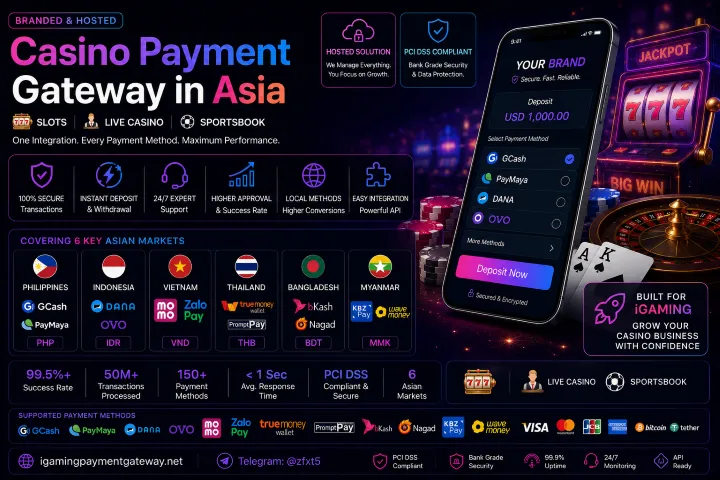
Casino Payment Gateway in Asia | Slots, Live, Poker | Branded: The Three-Tempo Stack One Casino Brand Actually Needs
A casino payment gateway in Asia that treats slots, live dealer, and poker as one undifferentiated cashier is leaving conversion on the table in all three. Each vertical has its own deposit rhythm, its own session shape, and its own risk profile — and a branded gateway worth the name tunes for each one without fracturing your brand across three separate sites.
Watch ten minutes of cashier traffic from a real Asian casino and you can almost guess which vertical the player is on without looking at the URL. The slots player makes three small deposits in twenty minutes. The live dealer player loads a bigger amount once and stays for an hour. The poker player tops up at the start of a tournament and disappears until they cash out four hours later. Same casino, three rhythms. The cashier has to serve all three without privileging any one.
Three Verticals, Three Cashier Personalities
Each casino vertical has a recognisable player profile that's been stable across markets for years. A branded cashier that doesn't shape itself around these profiles is essentially asking three different player types to use the same checkout designed for none of them.
The Player's Day, By Vertical
The three personas don't just deposit different amounts — they distribute their cashier interactions across the day completely differently. A 24-hour view makes the contrast obvious:
Slots traffic comes in dense, choppy bursts — multiple deposit events per session window. Live activity is one deposit followed by a long play tail. Poker is a single buy-in followed by hours of silence, then a withdrawal. If your cashier handles them all with the same risk velocity rule, the slots player gets velocity-flagged or the poker player gets ignored entirely.
The Shape of the Deposits, Not Just the Size
Look at deposits as a distribution rather than as a single average, and the three verticals come apart visibly. A slots-heavy operator has a deposit histogram piled toward the small end with a long tail. A live-heavy operator has a fatter middle and a heavier high-end. A poker-heavy operator has lumpy spikes at common buy-in sizes. None of these are "the same casino."
Three-Vertical Cashier Requirements, Side by Side
Translating the personality and shape differences into concrete cashier configuration: what changes for each vertical that the gateway actually has to handle differently?
| Dimension | 🎰 Slots | 🎲 Live | ♠️ Poker |
|---|---|---|---|
| Typical deposit size | Small, frequent | Mid-to-large, episodic | Buy-in clustered |
| Session length | Short bursts | 1–2 hours+ | 3+ hours common |
| Re-deposit pattern | Multiple per session | Rare top-up at table | Rebuy at tournament breaks |
| Velocity rules | Tolerate many fast deposits | Allow larger single submits | Cluster-aware around buy-ins |
| Withdrawal cadence | Occasional, smaller | Larger, less frequent | Bankroll-driven, planned |
| Device priority | Mobile-only friendly | Mobile + tablet equal weight | Desktop / multi-table aware |
| Trust-moment | First small withdrawal landing | First large withdrawal landing | Same-day cash-out after tourney |
Risk Profiles Are Not the Same Across Verticals
Fraud and abuse patterns also split along vertical lines. A risk engine that doesn't differentiate is either over-declining the legitimate players in one vertical or letting the bad actors through in another. The patterns to watch for differ:
Bonus-abuse rings
Coordinated low-stake play to clear welcome bonuses across multiple accounts. Pattern recognition matters more than per-transaction inspection.
VIP-segment fraud
Higher single-transaction values mean stolen-card attacks land harder. Identity and BIN intelligence on the cashier side matters disproportionately.
Collusion-adjacent flows
Funds-transfer patterns between players (chip-dumping equivalents) need monitoring at the payments layer, not just the game layer.
A branded cashier that runs the same fraud model across all three verticals catches less and over-declines more than one that tunes per vertical. This isn't a small detail — risk tuning is what decides whether your high-rollers get through and your abuse rings get caught.
The VIP / High-Roller Slice That Crosses Live and Poker
Where the High-Stakes Player Actually Lives
Across all three verticals, the high-stakes slice needs the cashier to behave differently from the mass-market default. A managed branded gateway handles this without separating into three sites — the same cashier surfaces appropriate limits and flows based on the player's vertical context.
How Three Cashiers Stay One Brand
The branding question is where most multi-vertical casinos lose coherence. The tempting fix is to spin up separate sites for slots, live, and poker — which fragments the brand and triples the operational load. The right answer is one branded cashier with three tuned profiles underneath:
One Brand. Three Tuned Profiles.
What stays the same across all three verticals
- Domain & visual identity
- Brand tone, microcopy patterns
- Login & KYC flow
- Trust signals, support presence
- Merchant display name on wallets
- Withdrawal-trust posture
What adapts based on what the player is playing
- Velocity and limits
- Default deposit-amount suggestions
- Risk model weights
- Withdrawal-window timing expectations
- Mobile / tablet / desktop priority
- VIP-elevation triggers
Asian Context for Each Vertical
Within Asia specifically, each vertical has its own cultural footprint — generally observable patterns, not absolute rules:
Slots in Asia
Mobile-first mass market with rapid adoption. Heavy use of local wallets for small frequent deposits.
Live Dealer in Asia
Culturally resonant — real dealers, social cues, table interaction. Often the highest-margin vertical for Asia-focused operators.
Poker in Asia
Solid mid-tier with hardcore community. Tournament traffic concentrates around scheduled event times.
The general industry framing — the customer types, the markets, the service model — is laid out across our industries we serve page. This article zooms specifically into the cashier-design implications of running multiple casino verticals through one branded stack.
The brand-sovereignty foundation underneath the per-vertical tuning is detailed in our branded payment gateway for gaming operators article. Three verticals on one brand only works if the brand foundation is solid in the first place.
Everything Else, Compressed
Scope of this article: The cashier-design implications of running slots, live dealer, and poker through one branded casino gateway in Asia — three player rhythms, three risk profiles, one brand surface.
Pricing: Flat monthly hosting fee + 0.1–0.4% transaction volume share — applied uniformly regardless of which vertical generated the volume. No per-vertical premium.
What you bring: brand decisions, merchant accounts, game platform context for each vertical you operate. What we run: the branded cashier with vertical-aware tuning, risk profiles per vertical, and unified analytics across all three.
Three-Vertical Cashier Questions
Do I need three separate cashier sites for slots, live, and poker?
No — and you actively shouldn't. Separate sites fragment the brand and triple the operational load. One branded cashier with vertical-aware tuning is the architecture that scales. Players move between verticals on a single platform constantly; they shouldn't have to re-onboard each time.
How does the cashier know which vertical a player is on?
The gameplay platform passes that context to the gateway. A managed integration uses it to set appropriate velocity rules, deposit-amount suggestions, and risk weights — invisibly to the player.
Won't tuning per vertical mean three sets of fraud rules to maintain?
Effectively yes — but they're maintained on our side as part of the managed model, not on yours. The benefit of per-vertical tuning massively outweighs the cost of running three rule sets, and the cost itself sits with the operator running the gateway, not the operator of the casino.
What about Asian VIPs — does the cashier need a separate flow for them?
Same cashier, elevated limits and white-glove withdrawal behaviour. The trigger for VIP behaviour is based on the player's history and stake patterns, not a separate site. A managed integration handles the elevation transparently rather than forcing the VIP through a different door.
Does running poker need different payment rails than slots?
Mostly the same rails (the local wallets and rails Asia uses for everything else), but with different velocity profiles and different default amounts. The shape of the deposits is what differs, not which methods carry them.
How does tournament peak traffic (poker) affect cashier capacity?
Tournament starts concentrate buy-ins into narrow windows. A managed gateway scales for those windows automatically; an unprepared cashier creates a queue that delays the very players you most need to process quickly.
Can I add a new vertical later (e.g., sportsbook) without rebuilding?
Yes. Adding a vertical is a configuration step in a managed branded stack — new risk profile, new default flows, same brand surface. The architecture is built around adding verticals, not around being locked to whichever three you started with.
The Next Step
A working casino payment gateway in Asia for slots, live, and poker isn't three websites stitched together. It's one branded cashier with three different rhythms underneath — each tuned so the player using it doesn't have to know any of this is happening. Operators who get this right run a single casino brand that converts in all three verticals; operators who don't tend to end up explaining to their highest-margin players why the cashier they trust on slots feels broken on live dealer.
Tell us which verticals you operate, where your highest-margin segment is, and which Asian markets you serve. We will scope a branded three-tempo cashier around your specifics and price it transparently.
One brand. Three tempos. One cashier.
Stop forcing slots players, live players, and poker players through the same checkout that was designed for none of them.
Scope My Casino Cashier →