
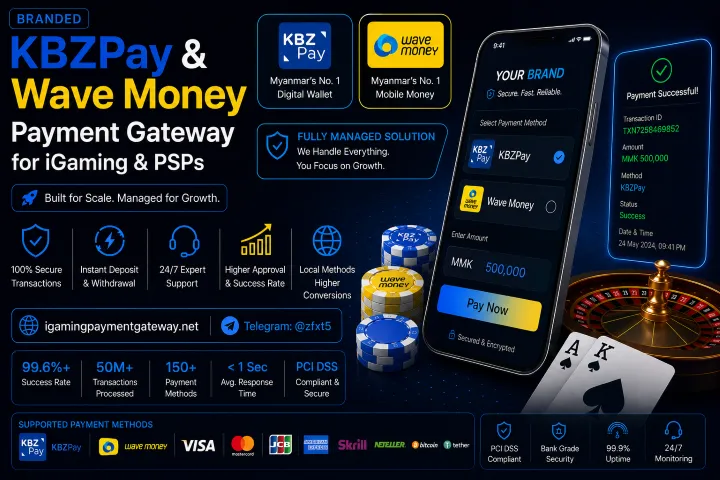
KBZPay and Wave Money Gateway for iGaming & PSPs | Branded: The Dual-Wallet Continuity Stack Myanmar's Cashier Actually Needs
A KBZPay and Wave Money gateway for iGaming & PSPs in Myanmar isn't a coverage question — it's a continuity question. The two wallets come from different worlds (one anchored in a major Myanmar bank, the other rooted in telecom-led mobile money), and that origin difference is the reason a serious branded cashier in Myanmar runs them as parallel rails, not as "primary plus backup." When one wallet has a quiet hour, the other has to carry your players through.
Every other dual-wallet market in our regional coverage has its own framing — parallel telco wallets in Pakistan, an incumbent-plus-challenger story in Bangladesh, super-app embedding in Vietnam, wallet-plus-bank evolution in the Philippines. Myanmar's framing is continuity, and this article is built around that lens.
Two Origins, One Country
KBZPay and Wave Money look superficially similar — both are mobile financial services that Myanmar players touch every day — but their corporate provenance shapes how they behave, how they handle limits, and how they respond when something goes wrong. Operators who skip this distinction treat the two as interchangeable and end up surprised when only one of them works on a given afternoon.
KBZPay
Wave Money
The practical consequence: when an iGaming player taps "deposit," the choice between KBZPay and Wave Money is not aesthetic. It reflects which of the two worlds that player lives in. Many Myanmar players use both, but most have a primary — and forcing them onto the other one is friction your funnel doesn't need.
The Continuity Premise: When One Rail Goes Quiet
The most honest reason for Myanmar's dual-wallet engineering isn't "market coverage," even though that's the conversation operators usually start with. The deeper reason is operational continuity. In an environment where partner-side outages, configuration changes, and connectivity variability are realities the cashier has to live with, two parallel rails is not a "nice to have." It's the architecture that decides whether your deposits keep flowing on a difficult afternoon.
"When One Goes Quiet" — Three Scenarios
The continuity logic above is abstract until you walk through specific failure moments. These three are the ones we see again and again in operator post-mortems for Myanmar — and the difference between a dual-wired cashier and a single-rail one is dramatic in each:
KBZPay and Wave Money, Side by Side
Beyond origin and continuity profile, the two wallets diverge across the same dimensions that matter for any cashier — flow type, merchant onboarding, callback patterns, payout routes. Below is the practical comparison most relevant for an iGaming integration:
| Dimension | KBZPay | Wave Money |
|---|---|---|
| Origin | Bank-backed (KBZ Bank) | Telco-rooted mobile money |
| Player identifier | Wallet account on mobile number | Wallet account on mobile number |
| Typical deposit confirm | PIN / app confirmation | PIN / app confirmation |
| Strongest reach | Bank-adjacent and urban | Broad agent / regional reach |
| Default player segment | Bank-comfortable users | Mobile-money-first users |
| Payout direction | Back to the same wallet account | Back to the same wallet account |
| Continuity role | Primary or secondary depending on time/region | Primary or secondary depending on time/region |
The Cash Layer That Still Sits Underneath
Unlike some regional neighbours where digital payments have eaten the cash economy almost entirely, Myanmar still runs a meaningful share of daily commerce through physical cash. The wallets sit on top of that reality rather than replacing it. For an iGaming cashier, this matters because your wallet balance often started as cash deposited at an agent shop earlier that week. The end-to-end money journey looks like this:
The Money Journey Behind a Myanmar Deposit
An iGaming "wallet deposit" is the visible tip of a longer chain. A clean cashier treats this with respect — clear amounts, fast confirmations, no ambiguous states.
The Burmese Script & MMK Localisation Layer
Myanmar UX is its own discipline — not a translated default
Burmese script and Myanmar Kyat (MMK) formatting are not edge cases for a Myanmar-facing cashier; they are the baseline. Merchant display names, transaction memos, support strings, error messages — anything the player reads inside KBZPay's or Wave Money's payment slip — benefits from being short, clear, and rendered correctly in the player's language preference.
MMK amounts also run into large nominal figures for everyday deposits, so UI components have to display them cleanly with proper thousand-separator conventions. A managed integration handles this as part of cashier setup rather than punting it onto your team.
For iGaming Operators & PSPs — Same Continuity Stack, Two Use Cases
The keyword for this article addresses both audiences deliberately. The same managed KBZPay + Wave Money stack serves both, but the framing differs:
Your Myanmar players stay whole, even on a bad afternoon
You run a Myanmar-facing platform. The dual-wallet cashier means a partner-side dip on one rail doesn't translate into a deposit blackout for half your funnel. Your merchant display name propagates onto both rails, and players see your brand whichever wallet they end up on.
The cashier is on your domain. The merchant identity is yours on each rail. The continuity posture is built in, not bolted on.
Sell Myanmar continuity downstream as a feature
You operate a payment business. Your downstream operators want a Myanmar stack that doesn't go dark when one wallet has a quiet hour. The managed model provisions per-tenant cashiers with per-tenant merchant identities on both KBZPay and Wave Money — and the continuity behaviour becomes a sellable property of your offering.
You sell their brand. We run both rails with monitoring. Their downstream players see continuity, not excuses.
The general framing of what "branded" means across this entire site — domain, merchant accounts in your name, the layers of sovereignty — is detailed in our branded payment gateway for gaming operators article. Myanmar is the case study where the continuity dimension of "branded" earns its weight.
Operational Notes Specific to Myanmar
A handful of practical realities that consistently shape a Myanmar deployment beyond the wallets themselves:
Broader Myanmar-market context — including the wider rail landscape, regulatory framing, and operator-side considerations — lives on the dedicated Myanmar gaming payment gateway page. This article keeps the lens specifically on the wallet pair and the continuity posture.
Everything Else, Compressed
Scope of this article: KBZPay + Wave Money as a dual-rail Myanmar stack for both iGaming operators and PSPs reselling downstream — framed around continuity, not just coverage.
Pricing: Flat monthly hosting fee + 0.1–0.4% transaction volume share — applied identically across both wallets, no per-rail premium.
What you bring: merchant relationships on each wallet (or willingness to set them up with us), branding decisions, customer relationships. What we run: the dual integration, smart routing, callback handling, payouts, monitoring, and on-call rotation calibrated to MMT.
KBZPay & Wave Money Specific Questions
Is one wallet "primary" and the other a backup?
No — and treating them that way is the failure mode this whole article is built around. Both wallets are first-class rails. Each one is "primary" for the segment of Myanmar players who use it as their default, and each one is the continuity rail for the segment that defaults to the other.
Are KBZPay and Wave Money interchangeable from an integration perspective?
No. Different operating entities, different merchant onboarding, different callback contracts, and meaningfully different failure modes. Treating them as one integration is the most common Myanmar-entry mistake.
What about other Myanmar wallets — AYA Pay, CB Pay, others?
KBZPay and Wave Money cover the dominant share of mobile financial services usage; other wallets play supporting roles for specific segments. Whether they belong in your cashier from day one depends on your player profile — that's a scoping conversation rather than a generic recommendation.
How does smart routing actually work between the two rails?
The cashier monitors approval rate and latency per rail in near-real time. When one rail degrades, the cashier surfaces the other one to the player more prominently — and if the routing engine determines the degraded rail is unlikely to complete the deposit, it doesn't even offer it. This is operated on our side, not your team's.
Does the cashier display in Burmese, English, or both?
Both. Player-facing surfaces respect a language preference and render correctly in Burmese script; backend tooling defaults to English for your operations team. A managed integration handles this without forcing your team to manage translation files.
What if both wallets degrade at the same time?
Rare, because they sit on different operational stacks — but if it happens, the cashier surfaces a clear status message to players and your ops dashboard pages immediately. Continuity is much higher with two rails than with one; it isn't an absolute guarantee, and we don't pretend it is.
Do I need a Myanmar entity to operate this?
The merchant-relationship layer depends on your operating model. The technology integration is structurally the same either way; entity questions belong in a scoping call rather than a public answer.
The Next Step
A working KBZPay and Wave Money gateway for iGaming & PSPs in Myanmar isn't "two wallets bolted together." It's a continuity posture wearing your brand on both rails — designed so the bad afternoons that hit every Myanmar-facing operator don't translate into a deposit blackout for your players. The operators (and PSPs) who get this right in Myanmar are the ones who shipped both rails from day one, with smart routing wired in, rather than treating the second wallet as a "next quarter" item.
Tell us your expected Myanmar monthly volume, whether you're an operator or a PSP, and whether you already hold merchant relationships on either wallet. We will scope a branded dual-wallet continuity stack and price it transparently.
Both wallets. One brand. Continuity built in.
Run Myanmar the way Myanmar's bad afternoons actually behave.
Talk to the Myanmar Team →