
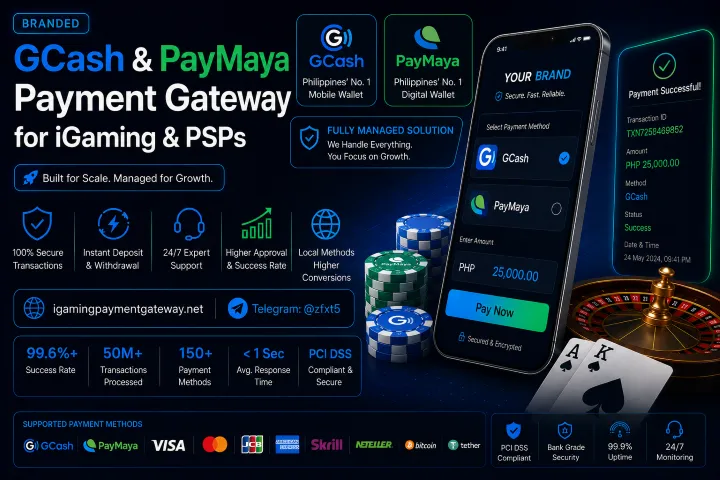
GCash and PayMaya Payment Gateway for iGaming & PSPs | Branded: When Your Players' Wallets Are Quietly Also Their Banks
A GCash and PayMaya payment gateway for iGaming & PSPs in the Philippines is a different conversation today than it was three years ago. Both wallets have grown out of "just mobile money" and into wallet-plus-bank hybrids — PayMaya has been rebranded to Maya and now operates its own digital bank, and GCash sits inside a stack of financial services that go well beyond a simple e-wallet. Treating either as a plain wallet integration is integrating yesterday's version of them.
For both iGaming operators and PSPs reselling rails downstream, that identity shift changes what a branded Filipino cashier should actually do — and where the real engineering work lives. This page is about that shift, with a deliberate lens on what makes the Philippines structurally different from neighbouring dual-wallet markets like Vietnam.
From Mobile Wallets to Wallet-Plus-Bank Infrastructure
Both GCash and PayMaya (now Maya) started as mobile money apps in the conventional Asian sense — a wallet on the phone, a top-up network on the street. Both spent the last several years building out beyond that core: investments, lending products, savings accounts, and in Maya's case a fully licensed digital bank. The transformation is structural, not cosmetic.
Mobile Wallet
Top-up, send, pay merchant. Stop.
Wallet + Financial Services
Savings, credit, investments bolted on top of the wallet.
Wallet-Plus-Bank
Maya runs a licensed digital bank. GCash sits inside a deep financial-services stack. Both are quietly bank-like.
Why a "Wallet" Identity and a "Bank" Identity Behave Differently
The reason this matters for an iGaming cashier is that wallet money and bank money flow through different parts of the Filipino financial system. Even when they both end up settling on similar underlying rails, the user experience, the limits, the cash-flow expectations, and the regulatory posture are not interchangeable. A managed integration treats them as one logical stack with two operational personalities:
The Mobile Money Layer
What players think of as "GCash" or "Maya" in casual usage. Fast, mobile-native, top-up-to-pay.
- Quick small deposits
- Phone-number-as-identifier UX
- Street-level cash-in network behind it
- Low-friction tap-to-pay
The Licensed Financial Layer
What the same brand also operates beneath the wallet — savings, transfers, deposits at bank-grade limits.
- Larger transactions, higher limits
- Real interbank reach via Philippine rails
- Bank-style consumer protections
- Withdrawals that land in account-style destinations
For the player, switching between these two identities is mostly invisible — they just tap the icon. For the gateway behind the cashier, choosing which layer to route through is a meaningful technical and operational decision per transaction class.
GCash and PayMaya, Side by Side
The two brands have similar consumer reach but distinct corporate parents, distinct internal architectures, and distinct best-fit use cases for an iGaming cashier. They are not "the same wallet with different logos."
InstaPay and PESONet — The National Rails Above the Wallets
The other piece of Filipino financial-rail context an iGaming cashier should respect is what sits above the individual wallets: the Bangko Sentral ng Pilipinas (BSP) — the central bank — has standardised two interbank payment rails, InstaPay and PESONet, that let money move between any participating wallet and any participating bank account. GCash and Maya both ride on this layer. Your cashier should too.
The practical consequence: a clean Filipino integration doesn't end at "GCash and Maya buttons." It also surfaces an InstaPay / PESONet path for players who prefer to push funds from their regular bank account into your cashier. Skipping that path leaves the bank-comfortable segment on the table.
English-Comfortable Financial UX Is a Filipino Advantage
The Philippines is one of the easier markets to localise a branded cashier into
English is widely used in Filipino financial UX, which means a clean cashier doesn't need a full-translation layer to feel native. That said, important pieces — merchant display name, transaction memo, support messaging — still benefit from being short, recognisable, and Philippines-appropriate rather than carbon-copied from a global default. The cashier is "easy to localise" — which is exactly why operators often don't, and lose the polish edge as a result.
The Remittance Layer Sitting Behind a Lot of Player Balances
One often-underappreciated piece of Philippine context: a meaningful share of GCash and Maya balances originates from Overseas Filipino Worker (OFW) remittances flowing home. Players' funds sit at the end of a long international money chain that other regional markets don't share in the same way. The implication for an iGaming cashier is not about regulation — it's about player relationship. The money in the wallet is often someone's hard-earned, recently-arrived family income. Cashier UX that respects that — clear amounts, fast confirmations, no ambiguous "did it work?" states — converts and retains better than aggressive default cashier patterns.
For iGaming Operators & PSPs — Same Stack, Two Use Cases
As with the parallel Vietnamese conversation in our MoMo and ZaloPay payment gateway for iGaming & PSPs article, the keyword here deliberately addresses two audiences. The same managed GCash + Maya stack serves both, but the mental model is different on each side:
Your players, your brand on the wallet slip
You run a Philippines-facing platform. Filipino players land in your cashier expecting GCash, Maya, and ideally a direct bank path. Your branded merchant display propagates onto each rail — the GCash slip, the Maya slip, the InstaPay reference — and every one of those is brand surface area.
The cashier is on your domain. The merchant identity is yours on every rail. The success-state return lands on your screen.
White-label the Filipino stack to downstream operators
You operate a payment business and your downstream operators want a branded Filipino cashier each. The managed model provisions per-tenant cashiers with per-tenant merchant identities — so the player ends up on a GCash or Maya slip showing their operator's name, not yours and not anyone else's.
You sell their brand. We run both wallets plus the rails above them. The wallet host shows each operator's merchant name at the moment of payment.
The general framing of what "branded" actually means for any payment gateway — domain, merchant accounts in your name, the layers of sovereignty — is detailed in our branded payment gateway for gaming operators article. The Philippines is a useful case study in how those principles extend cleanly into a wallet-plus-bank market.
Operational Notes Specific to the Philippines
A few practical realities about running these wallets at iGaming traffic levels in the Philippine market:
PHT timezone tempo
Philippines runs on GMT+8. Peak iGaming traffic lands on Friday and Saturday evenings local time; operations and on-call need to be calibrated to that window.
PHP amount conventions
Player UI shows Philippine peso amounts with thousand separators. Memos and references should be human-readable at a glance — Filipino players notice cluttered or cryptic strings.
Wallet ↔ bank crossover
Some players deposit via GCash and withdraw to a different bank account through InstaPay. Cashier flows need to handle this asymmetry without confusing the player about where their money is.
Mobile-number identifier consistency
Both wallets use the player's mobile number as an identifier. The cashier should validate the number format up front rather than failing inside the wallet handoff.
Independent failure modes
When one wallet has a partner-side issue, the other and the bank rails usually still work. A dual-wallet-plus-rails cashier degrades gracefully instead of going entirely dark.
Everything Else, Compressed
Scope of this article: GCash + PayMaya/Maya as a dual-rail Philippine stack for both iGaming operators and PSPs reselling downstream — with the wallet-plus-bank identity and the InstaPay/PESONet layer treated as first-class concerns.
Pricing: Flat monthly hosting fee + 0.1–0.4% transaction volume share — applied identically across both wallets and the bank-rail path, no per-rail premium.
What you bring: merchant relationships on each wallet, or willingness to set them up with us, plus branding and customer relationships. What we run: the dual-wallet integration, the bank-rail path, callbacks, reconciliation, monitoring, and weekend on-call calibrated to PHT.
GCash & PayMaya Specific Questions
PayMaya was rebranded to Maya — does the integration still work with the original name?
The brand is now Maya, and Maya Bank operates as a licensed digital bank under the same group. The underlying APIs and merchant relationships evolved with the rebrand; a managed integration follows whichever name and configuration is currently authoritative without you having to track the change.
Should I treat GCash and Maya as the same product with different logos?
No. They share consumer reach and broad payment behaviour, but the corporate parents, internal architectures, and bank-or-wallet posture are distinct. Treating them as one integration is the most common Philippine-entry mistake.
Do I really need InstaPay / PESONet support alongside the two wallets?
You don't strictly need it on day one, but you'll want it shortly after launch. A real segment of Filipino players prefers to push funds from their bank account rather than from a wallet, and the dual-wallet-only cashier misses them entirely. A managed integration wires these in alongside the wallets.
How does the wallet-plus-bank identity affect deposit limits?
The bank-side identity typically supports larger transactions than pure-wallet routing. For higher-stake casino and iGaming players, that matters — and the right routing decision happens per-transaction inside the gateway, not by forcing the player to pick a "mode."
What does a PSP get that an operator doesn't?
Per-tenant provisioning. A PSP can spin up multiple branded cashiers, each with its own merchant identity on each rail, with the underlying technology shared and managed by us. Operators usually want one branded cashier for one platform; PSPs typically want several.
Are the cashier and confirmations in English or Filipino?
The Philippines is comfortable with English in financial UX, so English defaults work — but key fields like merchant display name and memos still benefit from being short and recognisable to the Filipino reader. A managed integration tunes these rather than passing through global defaults.
Do I need a Philippine entity to operate this?
The merchant-relationship layer depends on your operating model. The technology integration is structurally the same either way; entity questions belong in a scoping call rather than a public answer.
The Next Step
A working GCash and PayMaya payment gateway for iGaming & PSPs isn't a wallet-only conversation anymore. It's a wallet-plus-bank stack with national interbank rails sitting above it, addressed to a player base that's already comfortable mixing both identities — and the operators (and PSPs) who get this right are the ones who designed for the wallet-and-bank reality from day one, rather than bolting a bank path on as an afterthought.
Tell us your expected Philippine monthly volume, whether you're an operator or a PSP, and whether you already hold merchant relationships on either wallet. We will scope a branded GCash + Maya stack — with the bank-rail layer included — and price it transparently.
Both wallets. Both rails. One branded cashier.
Run the Philippines the way Filipino players actually move money — wallet, bank, and back again.
Talk to the Philippines Team →