
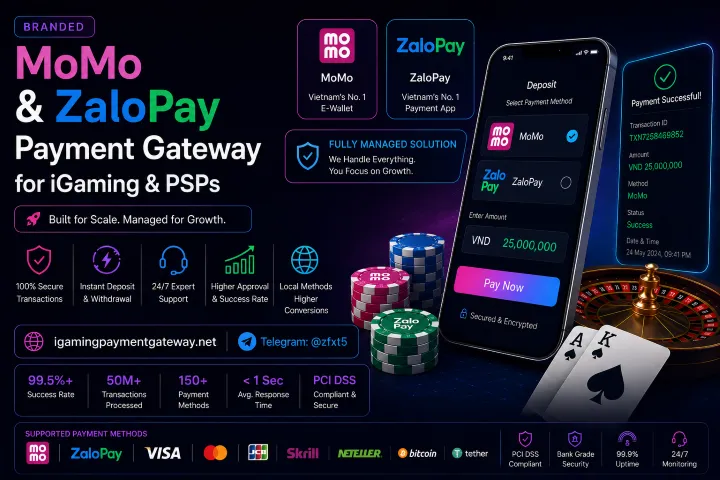
MoMo and ZaloPay Payment Gateway for iGaming & PSPs | Branded: Why Vietnam's Cashier Lives Inside Someone Else's App
A MoMo and ZaloPay payment gateway for iGaming & PSPs isn't just a "Vietnamese wallet integration." It's a branded payment surface that has to survive a moment most operators don't even realise happens: the second your player taps deposit, they leave your cashier and land inside Zalo or MoMo. What your brand looks like during those seconds, on someone else's app chrome, is the difference between a deposit and a drop-off.
Vietnamese wallets behave differently from Indian UPI or Pakistani / Bangladeshi mobile money — they live inside daily-life super-apps rather than in standalone wallet apps. That structural fact rewrites what "branded" means for a Vietnamese cashier, for both iGaming operators serving players directly and PSPs reselling the rails downstream.
Where the Deposit Actually Happens
Walk through the three stages of a Vietnamese deposit and the location of the player at each one. The middle stage is the one nobody talks about — but it's where the brand outcome is decided:
Your Branded Cashier
Player chooses MoMo or ZaloPay. Brand fully under your control.
Inside the Super-App
Player is pushed into Zalo or MoMo. Brand context shifts; the wallet's chrome surrounds the payment slip.
Return to Cashier
Player switches back to confirm. Brand returns to you — if the trail held.
The Super-App Wrinkle MoMo and ZaloPay Both Share
MoMo started life as a payments-first app and has been steadily extending into super-app territory: ride-hailing, bills, food, services — all tiled inside one home screen. ZaloPay was born inside Zalo, Vietnam's dominant messaging app, and is effectively a payments tile within a daily-communication context. Either way, the player is not opening "a wallet" — they are inside their everyday app and tapping pay.
MoMo — payments-first super-app
Player lives in MoMo for daily transactions; your payment slip appears as a sub-screen inside their home app.
ZaloPay — wallet inside the messenger
Players spend their day inside Zalo. ZaloPay slides up as a payment surface within that messenger context.
In both cases, the player's eye is on the wallet/host app chrome. The single most controllable touchpoint inside that chrome — and the one that almost every operator under-uses — is the merchant display name and reference text that gets passed along with the payment request. That is the moment your brand either carries through or dissolves.
The Brand Survival Map
"Branded" sounds binary. In a super-app-embedded Vietnamese deposit, it's a touchpoint-by-touchpoint audit. Here is which surfaces carry your brand, which carry the wallet's, and which are mixed:
| Touchpoint | Whose brand dominates? |
|---|---|
| Cashier URL / domain | YOURS |
| Method selection screen | YOURS |
| Hand-off transition (loading) | MIXED |
| Inside-wallet payment slip header | WALLET'S |
| Merchant display name on the slip | YOURS |
| Payment reference / memo | YOURS |
| Confirm / PIN screen | WALLET'S |
| Success screen (in wallet) | MIXED |
| Return-to-cashier screen | YOURS |
| Transaction history entry in wallet | YOURS |
| Withdrawal arrival notification | MIXED |
Of the four surfaces marked YOURS while inside the wallet, the most important is the merchant display name. A clean Vietnamese setup propagates a recognisable name into MoMo's and ZaloPay's payment slips. A sloppy one shows something cryptic that breaks player trust at exactly the wrong moment. A managed integration treats those propagated fields as branded surface area, not as throwaway metadata.
MoMo and ZaloPay, Side by Side
The two wallets cover overlapping but distinct corners of the Vietnamese market. Treating them as one integration misses the difference between "the player who lives in MoMo all day" and "the player who lives in Zalo all day." Both segments are real, and both are large enough to lose meaningful conversion if you skip them.
- Strong default for the payments-native user segment
- Wide presence beyond pure financial use cases
- Players who learned digital payments learned them here
- Branded merchant display propagates into the payment slip
- Default for the user who already spends the day inside Zalo
- Pay surface slides up from the messenger context
- Identity / contact context is already loaded — frictionless tap-to-pay
- Same branded-merchant-display principle applies on the slip
VietQR and the Interop Layer Above Both Wallets
Vietnam has a national QR interoperability standard — VietQR — that sits above the individual wallet apps. A well-designed cashier offers a single VietQR-compatible code that either wallet can scan, alongside the direct MoMo and ZaloPay deep-link buttons. Players who don't see their preferred entry point bounce; players who see all three (MoMo button, ZaloPay button, scannable VietQR) almost always find something they can use.
Three entry points, one branded cashier
The cashier surface offers MoMo deep-link, ZaloPay deep-link, and a VietQR-compatible QR code. Each entry point pulls the same branded merchant identity through into the host wallet.
QR is not a fallback in Vietnam — it's a primary flow, especially on desktop and tablet. Skipping QR support is leaving real conversion on the floor.
For iGaming Operators & for PSPs — Same Tech, Two Use Cases
The keyword combines two audiences deliberately. The same managed MoMo + ZaloPay stack serves both, but the mental model is genuinely different on each side:
Your players, your brand inside their wallet
You run a Vietnamese-facing platform. Every deposit your player makes is a brand impression — including the moments they spend inside MoMo or Zalo. Your job is to make sure your merchant display name, reference, and post-payment return flow all reinforce your brand instead of leaking it.
The cashier is on your domain. The wallet handoff carries your merchant identity. The success-state return lands on your screen.
Resell a branded Vietnamese wallet stack downstream
You operate a payment business. Your downstream operators want a Vietnamese cashier that wears their brand, not yours, not the wallet's. The managed stack lets you provision per-tenant branded cashiers with separate merchant identities on each — so when their player ends up inside MoMo or Zalo, it's the downstream operator's name on the slip, not anyone else's.
You sell their brand. We run the rails. The wallet host shows their merchant name at the only moment it matters.
Operational Notes Specific to Vietnam
Several practical realities about running these wallets at iGaming traffic levels are worth pinning down:
- Vietnamese-language fields: merchant display, memo, and error states should be in Vietnamese, not translated badly from English. A managed integration handles this on your behalf.
- GMT+7 weekend tempo: peaks land Friday and Saturday nights local time. Operations and on-call should be calibrated to that window.
- VND amount formatting: Vietnamese Dong amounts run into the millions for routine deposits. UI components have to handle five- and six-figure amounts without truncation.
- Deep-link reliability: the moment your cashier hands off into the wallet app is the single most common failure point. A managed stack monitors deep-link success rate as a first-class metric.
- Wallet-side outages: when either MoMo or ZaloPay has a partner-side issue, the other typically still works. Dual-wallet support is a continuity hedge, not just a coverage decision.
Most of this country context lives in more depth on our dedicated Vietnam gaming payment gateway page; this article keeps the focus on the wallet-and-branding lens specifically.
"Branded" in Vietnam vs Everywhere Else
The general framing of what "branded" means for a payment gateway — domain ownership, merchant accounts in your name, brand control across the surface — is covered on our branded payment gateway for gaming operators page. Vietnam is a useful case study in how the principle holds even when the player physically leaves your domain mid-deposit: branding becomes a relay rather than a single canvas, and the managed integration is what keeps the relay clean.
Everything Else, Compressed
Scope of this article: MoMo + ZaloPay as a dual-rail Vietnamese stack for both iGaming operators and PSPs reselling downstream. Other regional rails are out of scope and covered separately.
Pricing: Flat monthly hosting fee + 0.1–0.4% transaction volume share — applied identically across both wallets, no per-rail premium.
What you bring: merchant relationships on each wallet (or willingness to set them up with us), branding decisions, customer relationships. What we run: the dual integration, deep-link reliability, callbacks, reconciliation, payouts, VietQR support, monitoring, and weekend on-call.
MoMo & ZaloPay Specific Questions
What does the player actually see on the MoMo or ZaloPay payment slip?
A short merchant display name, the amount in VND, and an optional memo. The merchant display name is the most important branding hook — a managed integration makes sure it propagates a recognisable, branded string rather than something cryptic that breaks player trust.
Can I get away with just one of the two wallets?
You can ship one and add the other later — but Vietnamese players sort themselves between MoMo and ZaloPay by daily-app preference, and the ones whose preferred wallet you're missing almost always abandon rather than switch. The honest move is to launch both.
How does VietQR fit in alongside the direct wallet buttons?
VietQR is the national interop standard for QR-based payments. A clean cashier surfaces both: MoMo and ZaloPay deep-link buttons for the mobile-first flow, and a VietQR-compatible code for the desktop / tablet / "I'll scan from another phone" flow. They coexist and address different segments.
What's the difference between a PSP's white-label deployment and an operator's direct deployment?
Same underlying tech, different brand propagation. A PSP gets per-tenant branded cashiers and per-tenant merchant identities — each downstream operator's player ends up inside MoMo or Zalo seeing that operator's merchant display name, not the PSP's. An operator deployment is single-tenant: one brand, one merchant identity, end to end.
Are MoMo and ZaloPay interchangeable from an integration perspective?
No. Different merchant onboarding, different deep-link schemes, different callback contracts, different memo handling. Treating them as one integration is the most common Vietnam-entry mistake.
What happens to withdrawals through these wallets?
Withdrawals route back through the rail the player deposited on by default — MoMo deposits return to MoMo, ZaloPay deposits return to ZaloPay. Crossing rails is possible in some cases but produces a worse UX and adds delay; better to keep the same rail end-to-end.
Do I need a Vietnamese entity to operate this?
The merchant-relationship layer depends on your operating model. The technology integration is structurally the same either way; entity questions belong in a scoping call rather than a public answer.
The Next Step
A working MoMo and ZaloPay payment gateway for iGaming & PSPs isn't a "Vietnamese wallet plugin." It's a branded surface that propagates cleanly through someone else's super-app and brings the player back without losing the brand thread. Operators and PSPs who treat the hand-off into MoMo or Zalo as a designed moment, rather than a glitchy in-between, are the ones whose Vietnamese funnel actually converts.
Tell us your expected Vietnamese monthly volume, whether you're an operator or a PSP, and whether you already hold merchant relationships on either wallet. We will scope a branded dual-wallet stack and price it transparently.
Your brand. Their super-app. One clean hand-off.
Meet your Vietnamese player on whichever wallet they already live in.
Talk to the Vietnam Team →