
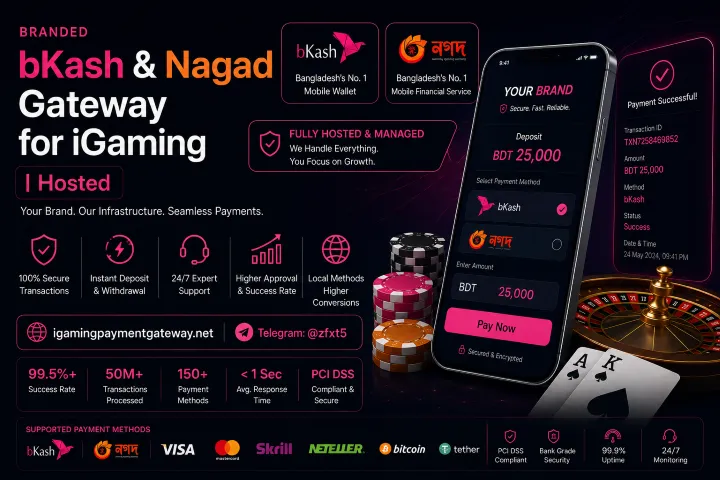
bKash and Nagad Payment Gateway: The Incumbent-Plus-Challenger Wallet Stack Bangladesh Actually Needs
A bKash and Nagad payment gateway only makes sense as a pair, because Bangladesh's mobile-financial-services landscape spent the last several years rearranging itself. bKash was the answer for over a decade; Nagad rewrote the question. Building a Bangladeshi iGaming cashier on one without the other is fighting yesterday's market — and quietly losing whichever side of today's player base you didn't pick.
This page is about the specific shape of that incumbent-plus-challenger dynamic, what it means for casino and iGaming traffic, and why a managed dual-wallet integration is materially different from "we added bKash, we'll see about Nagad next quarter."
The Wallet Shift Bangladesh Just Lived Through
For most of the last fifteen years, "Bangladeshi mobile wallet" effectively meant bKash. It was the default, the verb, the icon every cash-in agent had on their signboard. Then Nagad — a digital financial service launched in partnership with the Bangladesh Post Office — entered the picture, scaled aggressively, and reframed what "mobile financial services" in Bangladesh looked like as a competitive market rather than a single-rail monopoly.
bKash: The Incumbent. Nagad: The Challenger.
The two wallets are not interchangeable, and treating them as if they were is the most common Bangladesh-entry mistake. They were built on different foundations, they reach players through different defaults, and they carry different cultural weight on the player's home screen.
Your Player's Phone Number Is the Wallet
One thing both wallets share is a structural choice that matters at integration time: the player's mobile number is the wallet identifier. There is no VPA, no separate handle to remember, no QR scanning step. A clean Bangladeshi cashier respects this and asks for the mobile number directly — preferably with the country code pre-filled and the wallet brand selected up front.
The cashier flow players actually expect
Pick wallet → enter mobile number → confirm in the wallet app or via SMS/USSD flow → return to cashier. No extra handle. No QR. No fork.
Cashiers that bolt on Bangladeshi wallets by reusing an Indian or Pakistani flow almost always over-complicate this step. Bangladeshi players abandon faster than most when they see a screen that asks for something other than their phone number.
The Bangladeshi Weekend Is on a Different Calendar
Casino and iGaming traffic peaks on weekends. Most operator dashboards bake in the Saturday-Sunday assumption common in Western and Indian markets. Bangladesh's weekly rhythm is different. Friday and Saturday are the weekend; the working week begins on Sunday. If your gateway's risk tuning, payout windows or on-call rotation are calibrated around the wrong two days, you are leaking deposits and slowing withdrawals at exactly the worst time.
The Cash-In Network Behind the Wallets
bKash and Nagad don't just live in apps. They sit on top of a dense network of agents — corner shops, mobile-recharge counters, retail outlets — where players top up the wallet with physical cash. That network is the reason mobile financial services adoption in Bangladesh is so high in the first place. For an operator, this matters because it shapes who your player actually is: not just a smartphone user, but specifically a wallet user with the cultural muscle memory of walking down the street to top up.
Operational Realities Specific to bKash + Nagad
The dual-wallet engineering challenge in Bangladesh shares some shape with Pakistan's, but its specifics are its own. These are the operational considerations that consistently make the difference between "we support bKash and Nagad" and "we run them well":
Independent merchant relationships
bKash and Nagad are separate counterparties with separate onboarding documentation and timelines. They cannot be unified into a single application even if the legal entity behind your business is one.
Wallet-brand selection in the cashier UX
The player picks the wallet before entering their number. Mixing brands or auto-detecting them silently is a fast way to confuse the player into abandoning.
Friday–Saturday on-call rotation
Operations coverage shifts to match the local weekend. A team that sleeps on Saturday and works Sunday is asleep on Bangladesh's busiest day and busy on its quietest.
Distinct payout channels back to the player
A bKash-deposited player expects a bKash withdrawal; a Nagad-deposited player expects Nagad. Payout engineering needs both rails wired and tested end-to-end.
Resilience when one wallet has a bad day
If one rail tightens or experiences a partner outage, the other usually keeps working. A properly dual-wired cashier degrades gracefully instead of going entirely dark for Bangladeshi players.
How This Differs From the Pakistani Dual-Wallet Pattern
We've already written about the equivalent dual-wallet conversation in Pakistan; the structural pattern of "two wallets, both required" looks similar at first glance. But the underlying market dynamics are quite different, and operators benefit from holding both pictures in their head before launching into either country:
Bangladesh dual-wallet vs Pakistan dual-wallet
| Aspect | Bangladesh (bKash + Nagad) | Pakistan (JazzCash + Easypaisa) |
|---|---|---|
| Market history | Long single-leader, then disrupted by a challenger | Parallel telco-led wallets running side by side |
| Operating background | BRAC Bank affiliation / Post-Office partnership | Jazz telecom / Telenor + Easypaisa Bank |
| Player identifier | Mobile number is the wallet handle | Wallet account on mobile number, MPIN-driven |
| Weekend calendar | Friday–Saturday | Saturday–Sunday |
| Narrative framing | Incumbent + Challenger | Two parallel giants |
Everything Else, Compressed
Pricing, the broader market list, the managed-infrastructure breakdown and customer-type personas live on the main service page so we don't repeat them here. The short version:
Scope of this article: bKash + Nagad as a dual-rail Bangladeshi stack for casino & iGaming. Other regional rails are out of scope and covered separately.
Pricing: Flat monthly hosting fee + 0.1–0.4% transaction volume share — applied identically across both wallets, no per-rail premium.
What you bring: merchant relationships on each wallet, or the willingness to set them up with our guidance. What we run: the dual integration, callbacks, reconciliation, payouts, monitoring, and Friday–Saturday on-call.
Full Bangladeshi market context — including broader rails, regulatory framing and operator-side considerations — sits on the dedicated Bangladesh iGaming payment gateway page.
Running Pakistan too? Different country, same dual-wallet logic.
See how the parallel Pakistani stack handles its own two-wallet market.
See the Pakistan Wallet Stack →bKash & Nagad Specific Questions
If bKash is the incumbent, can I just start there and add Nagad later?
You can — but every Bangladeshi player who tried to deposit via Nagad and couldn't is a player who probably doesn't come back. The honest call is to ship both at launch and treat the cost as a market-entry tax rather than something to optimise out.
Is the player's mobile number really the only identifier?
For these wallets, yes — the registered mobile number is the wallet. There is no separate handle to enter. Cashiers that ask for anything else are leaking players who don't know what's being requested.
What about other Bangladeshi rails — Rocket, banks, cards?
bKash and Nagad cover the bulk of the wallet usage; Rocket and bank-card rails play supporting roles for specific segments. The right combination depends on your player profile and is part of scoping rather than something to prescribe generically.
How do withdrawals back to the same wallet work?
Withdrawals route back through the rail the player deposited on — bKash money returns to a bKash wallet number; Nagad money returns to a Nagad wallet number. Cashiers that try to cross the rails are creating support tickets they don't need.
Does the Friday–Saturday weekend actually change how the gateway needs to operate?
Yes. On-call rotations, withdrawal cut-off times, monitoring escalation calendars and even feature-release windows all benefit from being calibrated to the Bangladeshi week rather than a global default. A managed model handles this on your behalf.
What happens if one wallet's policies tighten for high-risk verticals?
The other usually continues operating, and players can complete deposits on whichever rail is healthy. A dual-wired cashier is also a continuity hedge against single-rail policy events.
Do I need a Bangladeshi entity to operate this?
The merchant-relationship layer depends on your operating model. The technology side is structurally the same either way; entity questions belong in a scoping call rather than a public answer.
The Next Step
A working bKash and Nagad payment gateway is not "bKash plus some Nagad on the side." It is two parallel integrations, two parallel merchant relationships, and one cashier that respects the player's right to use the wallet they actually have on their home screen. Operators who get this right in Bangladesh are the ones who started with the incumbent-plus-challenger framing from day one, not the ones who half-shipped and tried to patch later.
The next step is short. Tell us your expected Bangladeshi monthly volume, your target player profile, and whether you already hold merchant relationships on bKash or Nagad. We will scope a dual-wallet stack and price it transparently. Conversations are free.
One stack. Two wallets. Today's Bangladesh.
Meet your player on whichever wallet they actually use.
Talk to the Bangladesh Team →