
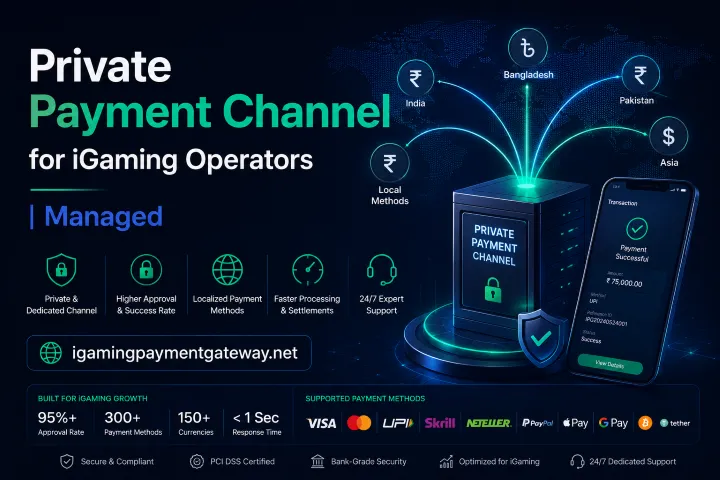
Private Payment Channel: Why a Pipe You Share With Strangers Always Costs More
A private payment channel is a payment route used by your business and your business only — no shared MID pool, no co-tenant risk, no inherited fate when someone else on the same vendor platform misbehaves. For iGaming operators and PSPs, this distinction quietly decides whether your channel stays alive through the next bad weekend.
Most operators don't think about whether their gateway is "private" or "shared" — until the day they discover, far too late, that they were sharing. This page is about that distinction, what it actually means inside the plumbing of a payment system, and why the cost of not being private only shows up after the damage has already happened.
What "Private" Really Means in a Payment Channel
In payments, "private" is a precise technical word, not a marketing one. There are three layers where a channel can be private — or not — and the difference matters at each one:
- Private tenancy — the gateway instance is dedicated to your business. Your traffic, your config, your logs. Not a shared multi-tenant SaaS where you're one of hundreds in the same database.
- Private MIDs — the merchant identifiers behind the channel belong to your company. Acquirers see your name, not "Vendor X — sub-merchant #4827."
- Private settlement — funds flow into accounts in your name, not a pooled vendor wallet that pays you out on a schedule.
Most "gateways for hire" are private on zero of these three. A handful are private on one. Almost none are private on all three. Without all three, what you really have is a brand wrapper around a shared pipe — and the pipe is what gets squeezed.
Shared Pipe vs Private Pipe — The Architecture That Decides Your Fate
The clearest way to see the difference is to lay both architectures side by side. On the left is what most operators are actually running today, whether they realised it or not. On the right is what a private channel looks like.
SHARED CHANNEL (the default)
PRIVATE CHANNEL (this product)
The Three Things You Inherit From Strangers
Sharing a channel doesn't just mean smaller margins or vague "platform fees." It means inheriting the consequences of decisions other tenants made — usually decisions you never knew about until the fallout hit your cashier. Three patterns repeat, week after week, in operator post-mortems:
None of these are your fault. You ran a clean operation. You watched your own metrics. It didn't matter — because in a shared channel, fault is collective. A private channel is the only architecture where "running a clean operation" actually translates into "your channel stays healthy."
What a Private Channel Actually Isolates
Saying "private" is one thing. Listing exactly what gets isolated is another. Here is what a real private channel on our platform separates from everyone else's traffic:
Risk Scoring
Your transactions are scored against your own history, not a pooled portfolio. A neighbour's fraud doesn't change how the engine reads your player.
Chargeback Ratio
Your chargeback rate is your chargeback rate. Other businesses can't push the MID over a threshold and drag you with them.
Settlement
Funds flow from acquirer directly to your account, with no pooled vendor wallet in between. Reserves and holdbacks are negotiated against your business, not a portfolio average.
Compliance Posture
If someone in another vertical attracts regulator attention, that doesn't quietly tighten the screws on your KYC and limits. Your compliance scope is yours.
Outage Blast Radius
A bug or DDoS aimed at a co-tenant doesn't take your cashier down. Dedicated instance = dedicated availability profile.
Method Availability
If a payment method gets disabled because of how a neighbour was using it, your access isn't automatically cut. You decide which rails stay on for your players.
When "Going Private" Stops Being Optional
A shared channel may genuinely be fine when you are testing a new market with low volume and casual stakes. The economics of "going private" sharpen as your business does. These are the inflection points where the conversation changes from "should we?" to "we should have done this six months ago":
You hit volume that makes you visible
Once your traffic is a meaningful slice of the shared MID, you become the largest source of risk it sees — and the largest victim of any pool-wide tightening. Past a certain volume, you're paying a premium for sharing without getting the benefit of small-fish anonymity.
You operate in a sector that regulators treat as high-risk
iGaming, betting and adjacent verticals get tagged. The moment your category co-mingles with riskier ones on the same MID, you inherit the worst-case regulatory posture — even if your own license and compliance are pristine.
You're scaling into more than one country
Each market has its own rails, rules and risk profile. A shared multi-country pool averages out the worst behaviours of all the geographies your neighbours operate in. A private channel lets each market be tuned on its own terms.
Your cash flow can't tolerate a 30-day surprise
If a delayed settlement, an unscheduled reserve increase, or an account freeze would damage payroll or weekly operations, the shared model is borrowed time. Privacy is the only architecture that puts cash flow back under your roof.
Private Channel vs Branded Gateway — Are They the Same Thing?
They are related, not identical — and the distinction is worth keeping clear. Branded is about whose name the player sees in the cashier and URL bar. Private is about whose traffic shares the pipe behind the scenes. You can have one without the other — most "branded" reseller cashiers are still shared underneath the paint job.
A properly private channel on our platform is also branded by default — your domain, your UI, your name — but the central promise of this page is the architectural isolation, not the visual layer. If the branding/sovereignty angle is what you came for, the dedicated page on branded payment gateway for gaming operators covers that lens in depth.
Everything Else, Compressed
Coverage, pricing and onboarding are shared facts that apply to every page on this site, so we don't repeat them here. The short version:
Coverage: Private channels operate across India, Pakistan, Bangladesh, Vietnam, the Philippines and Myanmar with locally dominant rails pre-integrated.
Pricing: Flat monthly hosting fee + 0.1–0.4% transaction volume share. No reseller margin, no FX games.
For the full picture — including detailed pricing, full market list, complete pain analysis, onboarding flow and customer-type breakdown — see the main iGaming payment gateway service page.
Stop sharing your channel with strangers.
Get a private-channel scope for your business and target markets.
Scope My Private Channel →Questions Specific to Going Private
How do I know if my current gateway is actually private?
Three quick tests. First, ask your provider for the exact MID your transactions hit the acquirer under — if it's a shared one, you're on a pool. Second, ask whether funds settle directly from the acquirer to your bank, or through a vendor wallet. Third, ask whether your risk and chargeback metrics are scored individually or against a portfolio. If any answer is vague or "it depends," you are almost certainly on shared infrastructure.
Is a private channel slower or more expensive to launch than a shared one?
The provisioning work is heavier — a dedicated instance, dedicated MID setup, dedicated settlement plumbing. But because we operate the entire stack on our side, the time-to-live for our customers is measured in days, not months. The cost is structured as a flat monthly hosting fee plus a 0.1–0.4% volume share, with no per-transaction reseller margin layered on top.
Does private mean I have to bring my own merchant accounts?
Yes — that's part of what makes it genuinely private. You bring the acquiring relationships and merchant accounts, and we wire them into a dedicated gateway instance. This is the same model used across our platform: it's what keeps the channel structurally yours, not a sub-account on someone else's tree.
Can a private channel still scale with my volume?
Yes. Private doesn't mean small. Dedicated infrastructure scales horizontally for your traffic specifically — and unlike a shared pool, you don't compete for capacity with other tenants during peak windows. The cleaner the architecture, the easier the scaling.
What if I'm a PSP — does "private channel" still apply to me?
Yes, but the framing flips. As a PSP, your private channel becomes the dedicated infrastructure you sell to your downstream merchants. They get the cashier; you get the isolation from other vendors' contagion risk. The architecture story above is the same; the audience for the brand is different.
What happens to my private channel if you go out of business?
The merchant accounts, acquiring relationships, customer database and domain are all in your name from day one. We operate the technology, but we don't hold the structurally critical assets. Continuity planning is a normal part of scoping — ask us directly.
The Next Step
The hardest part of choosing a private payment channel is recognising you needed one before the weekend that proved it. Operators who make the move proactively — after looking honestly at the contagion timeline above — never go back to shared infrastructure. Operators who wait usually make the same decision, but under worse circumstances and in a hurry.
The next step is short: tell us your expected monthly volume, target markets, and whether you're an operator running a single platform or a PSP reselling to downstream merchants. We will scope a private channel for your situation and price it transparently. Conversations are free.
Your channel. Your traffic. Your fate.
No more inheriting someone else's bad weekend.
Talk to the Team →