
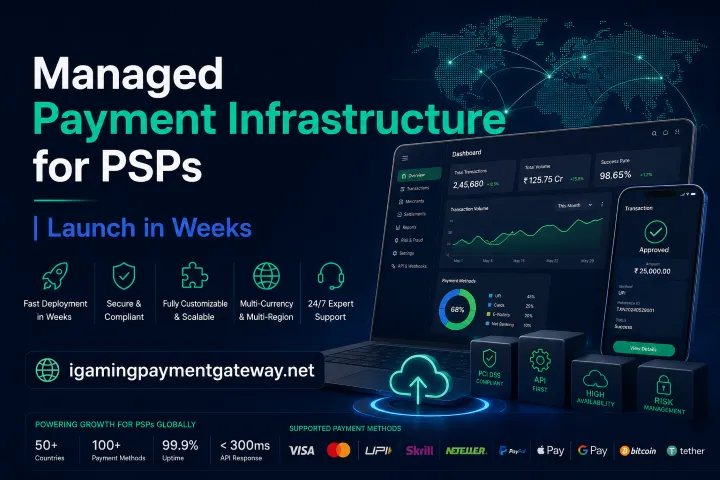
Managed Payment Infrastructure: 14 Things You'd Otherwise Have to Build, Hire, or Wake Up For
Managed payment infrastructure is the deal where someone else owns the engineering, the servers, the security posture and the on-call pager — while you keep the brand, the customers and the cash flow. For iGaming operators and PSPs, that division of labour is the difference between launching a real channel in days and quietly building a payment company on the side for two years.
Every operator who has tried the alternative knows the story: payments looks like "we just need a checkout," and then it slowly becomes a parallel engineering organisation. Reconciliation jobs. PCI scope. Webhook retries. Acquirer downtime. Certificate rotations at 2 a.m. The page you're reading is about the version where none of that lands on your desk.
The Cashier Is the Tip of the Iceberg
Players see one thing: a deposit button on a clean cashier. Behind that button is a stack most operators have never been forced to itemise. Visualising it tends to be the first time the scope of "managed" sinks in:
Every block under the waterline is a real piece of work. Each one has failure modes, vendor contracts, and someone whose job is to make sure it doesn't break at peak hour. In a managed model, that "someone" is us. In a DIY model, that someone has your title.
The 14 Layers We Operate on Your Behalf
Here's the same stack written out explicitly. Each layer is a distinct discipline — and each is something you'd otherwise be staffing for, contracting out, or learning the hard way. We list all 14 because vague promises like "we handle everything" don't survive a real procurement conversation:
The Team You'd Otherwise Have to Hire
Building this stack in-house is rarely framed honestly when operators first consider it. The real shopping list isn't "a payments engineer." It's a full functional team — most of whom need to be senior, several of whom need to be on a pager rotation. These are the roles a managed model removes from your org chart:
Payments Backend Engineer
Builds and maintains the gateway core: API, routing, retry logic, webhook delivery, reconciliation. The keystone hire — and the hardest to find for emerging-market rails.
DevOps / Site Reliability Engineer
Owns hosting, deployments, scaling, monitoring, incident runbooks. Required from day one or your launch happens on someone's laptop.
Security & PCI Compliance Lead
Designs and defends the PCI DSS scope, runs quarterly scans, manages vendor risk, owns the answer to "what happens if we get breached?"
Local Methods Integration Engineer
Specifically knows UPI, bKash, JazzCash, MoMo, GCash and the regulatory quirks behind each. Often impossible to hire in the timeframe you need.
Risk & Fraud Analyst
Tunes rule sets, watches dashboards, distinguishes legitimate whales from card testers. Without this role, you over-decline or get rinsed.
24/7 On-Call Engineers
Around-the-clock coverage requires at least three engineers to sustain humanely. Burnout from a two-person rotation is the silent killer of payment teams.
A managed model collapses all six of these roles — plus their backups, training plans and ramp-up time — into a single line item on your invoice. That isn't a marketing claim; it's a labour-market reality.
A Day in the Life of Your Infrastructure
"Managed" sounds abstract until you see what specifically happens around your business while you're not watching. A typical 24-hour cycle behind the curtain looks something like this:
⏱ 24 Hours Behind the Curtain
Managed vs Building It Yourself
The honest comparison isn't "is managed cheaper?" It's "what happens to your roadmap when payments competes for attention with your actual product?" Operators who built in-house describe the same trajectory:
The Shared Facts, In One Box
Pricing, supported markets, customer types and onboarding sequence are detailed on the main service page so we don't repeat them here. The compressed version:
Coverage: 6 South / Southeast Asian markets with locally dominant rails (UPI, bKash, JazzCash, MoMo, GCash and others) pre-integrated.
Pricing: Flat monthly hosting fee + 0.1–0.4% transaction volume share. No reseller margin layered on top.
What you bring: brand, domain decision, merchant accounts. What we run: all 14 layers above.
For the full service breakdown — including customer-type personas, full pricing model, complete onboarding flow and detailed market coverage — see the main iGaming payment gateway service page.
Stop building a payment company on the side.
Get a managed-infrastructure scope for your launch — engineering, security, on-call, everything.
Hand It Over →Managed-Model Specific Questions
Do I get any visibility into what's happening on the infrastructure?
Yes — you get a real-time dashboard for transactions, approval rates, settlement status and route health. The point of "managed" is that you don't have to act on what you see, not that you're blind to it.
What's the SLA on incidents?
Production incidents are responded to within minutes by our on-call rotation. The exact targets — response time, resolution time, severity definitions — are part of your service agreement and are scoped to your traffic profile rather than a generic shared-tenant policy.
What happens if you ship a buggy release?
The same thing that happens at any mature infrastructure shop: feature flags, staged rollouts, automated rollback, postmortems shared with you. You will not be the canary that finds the bug — your traffic only sees changes that have already cleared upstream environments.
Can I get an audit log of changes made to my environment?
Yes. Every configuration change, deployment, and access event on your instance is logged and retrievable. Auditors expect this; we expect auditors.
What if I want to migrate off your platform later?
The structurally critical assets — domain, merchant accounts, customer database, transaction history — are yours from day one. Exit assistance is part of standard engagement terms; we'd rather have you stay because the service is good than because the door is locked.
Will I have a single point of contact, or am I in a ticket queue?
Single point of contact. After go-live, you have a dedicated account manager and direct technical channel for new requirements. The 24/7 incident channel is separate and always-on.
Is "managed" the same as a SaaS multi-tenant gateway?
No — and that distinction is important. Multi-tenant SaaS shares infrastructure across all customers, which exposes you to a different class of risks. Our managed model gives each customer a dedicated environment that we operate. You get the labour benefits of SaaS without the tenancy compromises.
The Next Step
Managed payment infrastructure is, in plain terms, a trade: you give up the temptation to build payments yourself, and you get back the engineering bandwidth, calendar time and weekend sleep that would otherwise go into it. For operators whose actual product is a game — not a gateway — that trade is almost always the right one.
The next step is short. Tell us your expected monthly volume, the markets you want live among the six we cover, and the merchant accounts you're bringing. We will scope a managed infrastructure plan and a price, both transparent. From scoping call to live cashier is a matter of days, not quarters.